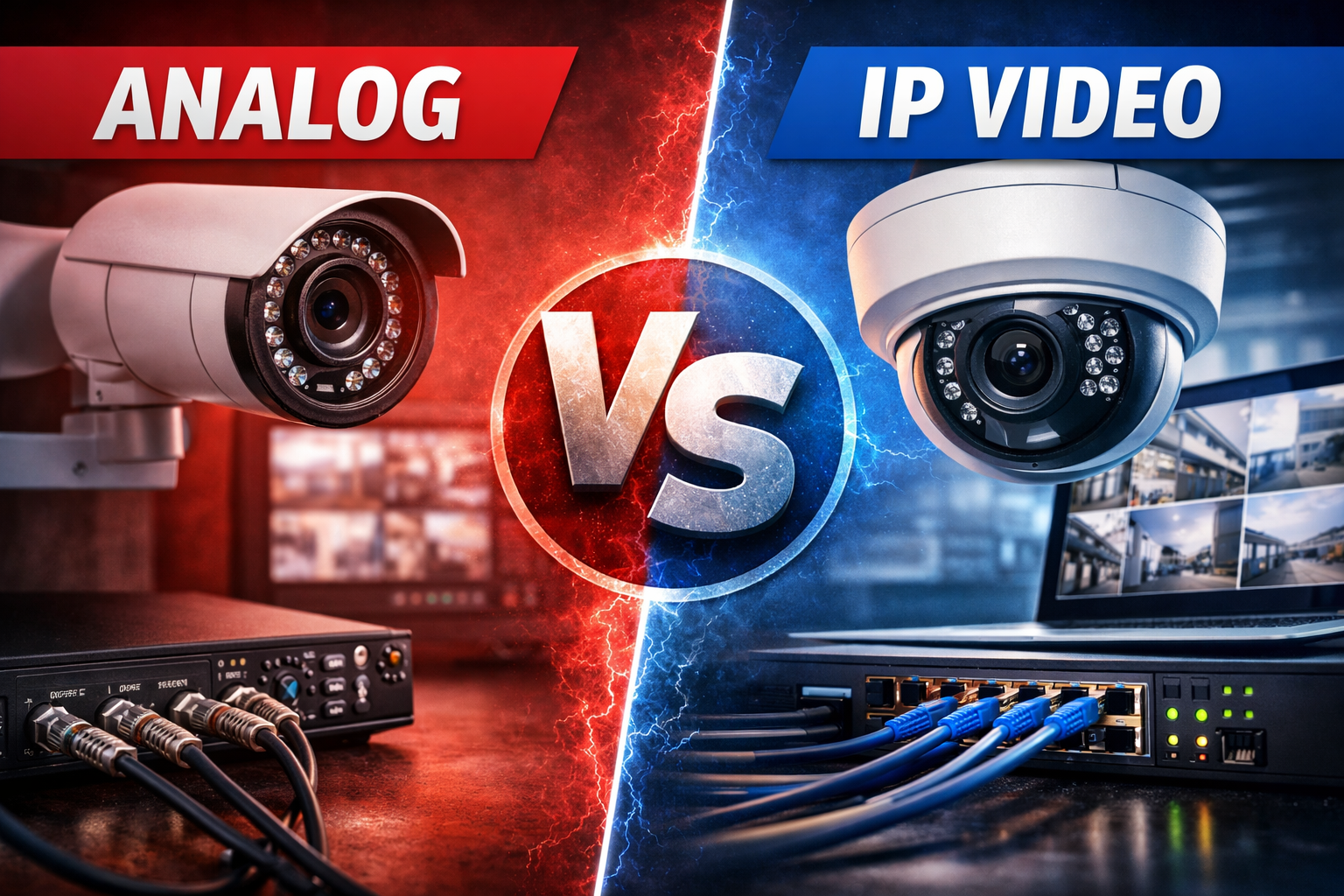
Comparing Analog and IP Video Surveillance Systems
If you’re evaluating a new commercial video surveillance system or considering an upgrade, one fundamental question usually comes first:
Should you choose analog cameras or IP (digital) cameras?
While both technologies still exist, the difference between them and what that difference means for reliability, image quality, scalability, and long-term value is much clearer today than it was a decade ago.
This guide explains the practical differences between analog and IP video surveillance systems so you can make an informed decision based on your business needs, not marketing buzzwords.
The Two Types of Video Surveillance Systems
At a high level, commercial surveillance systems fall into two categories:
1. Traditional Analog Camera Systems
- Cameras transmit video over coaxial cable
- Footage is recorded on a DVR
- Image quality is limited
- System flexibility is minimal
2. IP (Internet Protocol) Camera Systems
- Cameras transmit digital video over a network
- Footage is recorded on an NVR or server
- Higher resolution and clarity
- Easily scalable and upgradeable
While both systems can still be found in the field, nearly all new innovation and long-term investment is happening in IP video.
Why the Terminology Gets Confusing
Anyone researching security cameras quickly runs into a flood of technical terms:
Analog, digital, megapixel, HD, 1080p, 4K, VGA, XGA, QXGA, lux ratings, pixels, DVRs, NVRs, NAS, ONVIF, H.264, H.265…
Unless you work in the industry, sorting through all of that detail is time-consuming and often unnecessary.
Instead of starting with specs, the better approach is to start with purpose.
Start With the Right Question
Before choosing a camera type, ask:
What are you trying to accomplish with these cameras?
Examples:
- Identify faces or license plates
- Monitor large areas or yards
- Reduce theft or vandalism
- Investigate incidents
- Support safety or compliance
- Enable remote monitoring
The clearer the objective, the easier it is to choose the right technology.
Benefits of IP Video Cameras
For most commercial and industrial environments in 2025, IP cameras offer clear advantages.
Key Benefits of IP Systems
- Scalability: Easy to add cameras as your business grows
- Higher image quality: Megapixel and 4K resolution provide usable detail
- Better performance in challenging lighting
- Future-proof design: Software, analytics, and integrations continue to evolve
- Efficient coverage of large areas
- Remote access and monitoring
IP systems also integrate more easily with modern features such as AI analytics, health monitoring, and proactive service models.
This is why IP video has become the standard for serious commercial security deployments.
When Analog Systems May Still Be Sufficient
While IP video is the preferred solution in most cases, analog cameras can still make sense in very limited situations.
Analog may be sufficient if:
- Budget is extremely constrained
- The number of cameras is small and fixed
- High image detail is not required
- Cameras are placed in small, well-lit areas
- Existing coaxial infrastructure must be reused
That said, analog systems offer little flexibility for future upgrades and often cost more over time as maintenance and limitations add up.
Image Resolution and What Businesses Actually Need
Resolution is one of the most misunderstood aspects of camera selection.
For most commercial applications:
- 1MP–6MP cameras meet the majority of needs
- Higher resolution is useful for wide areas or forensic detail
- More pixels are not always better if placement and lighting are wrong
The goal is usable video, not just higher numbers on a spec sheet.
Why Camera Quality Matters More Than You Think
One important reality many buyers overlook:
Installation labor, cabling, and configuration typically account for about 50% of total system cost.
That means the difference between a low-quality camera and a high-quality camera is often small compared to the overall investment.
For that reason, it usually makes sense to:
- Choose proven, reputable manufacturers
- Invest in cameras built to last
- Avoid systems that will need replacement in a few years
Cheap cameras often cost more in the long run.
The Direction of the Industry Is Clear
While analog systems still exist, the surveillance industry’s future is firmly digital.
IP video continues to advance in:
- Image quality
- Reliability
- Analytics and automation
- Remote diagnostics
- Long-term flexibility
For businesses planning beyond the next year or two, IP video is the smarter long-term choice.
Our Recommendation
At Vulcan Security Systems, we help clients choose systems based on real-world performance, not trends.
In most commercial and industrial environments, we recommend:
- Open-platform IP video systems
- High-quality cameras from established manufacturers
- Designs that prioritize clarity, reliability, and future expansion
The right system is the one that delivers usable footage when it matters, not the one with the longest spec sheet.
Talk With an Expert Before You Decide
If you’re considering a new system or upgrading an existing one, a short planning conversation can save you years of frustration.
Contact Jason Maddox at Vulcan Security Systems for a free consultation on IP video surveillance for commercial properties in Birmingham and throughout Central Alabama.
We’ll help you define your goals, evaluate your options, and design a system that works the right way from day one.