
Complete Guide to Modern Video Security Camera Options for Businesses
If you’re evaluating security camera options for your business, the landscape probably feels more complex than ever. Cameras now come with AI analytics, multi-sensor designs, cloud connectivity, cybersecurity requirements, and enough marketing jargon to overwhelm even seasoned facility and operations leaders.
This guide cuts through the clutter. In plain English, you’ll learn the main types of commercial security cameras, the technology that actually matters, and how to choose the right mix for your facility, without overbuying or relying on outdated hardware.
As always, at Vulcan Security Systems, we help clients make smart, long-term decisions about their IP video systems. This article gives you the foundational knowledge to do the same.
Table of Contents
- How Modern Security Cameras Have Changed
- Analog vs. IP Cameras in 2025
- Open-Platform vs. Proprietary Systems
- The Core Camera Types Businesses Use Today
- Low-Light, Environmental & Industrial Considerations
- Modern Camera Features That Actually Matter
- How These Cameras Work With Monitoring & AI
- The Bottom Line: What Delivers the Best ROI
- How Vulcan Helps You Select the Right System
How Modern Security Cameras Have Changed
A lot has changed since I originally wrote this article in 2017. Back then, IP video was gaining traction, but most systems still relied on simple motion detection and basic network cameras. Today’s commercial cameras are dramatically more capable.
The biggest leaps in the last decade include:
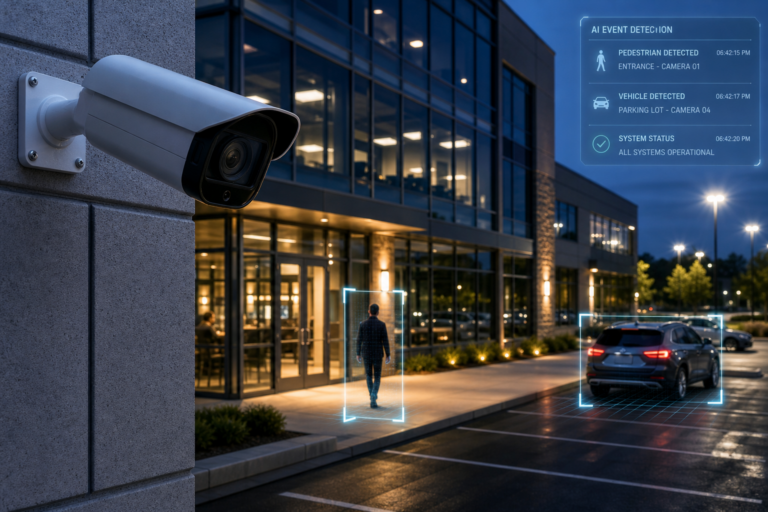
- AI-native analytics that detect humans, vehicles, behavior patterns, PPE compliance, loitering, trespassing, and more.
- Multi-sensor cameras that deliver 180° and 360° views without needing multiple units.
- Ultra-low-light color imaging that captures full-color footage at night.
- Thermal + optical fusion for zero-light areas or perimeter monitoring.
- Edge computing, meaning the camera processes events internally instead of relying entirely on servers.
- NDAA-compliant hardware with hardened cybersecurity protections.
- Remote health monitoring, allowing service providers like Vulcan to fix issues without rolling a truck.
Modern cameras aren’t just recording devices anymore, they’re intelligent sensors that help businesses reduce risk, improve safety, and eliminate the need for on-site guards.
Analog vs. IP Cameras Today
Analog cameras no longer make sense for commercial or industrial environments. IP cameras have fully taken over.
Why?
- Analog image quality is too low for evidence or identification.
- No AI or modern analytics.
- Very limited storage and flexibility.
- Not cyber-secure.
- Costs more to maintain long-term.
In contrast, IP cameras (megapixel cameras) offer:
- 4MP–12MP clarity
- Digital zoom with evidentiary detail
- AI analytics
- Remote access
- Integration with modern monitoring services
- Long-term scalability
If you’re upgrading or building a new system, IP is the only viable path. Read More
Open-Platform vs. Proprietary Systems
This is one of the most important and most misunderstood, parts of selecting a camera system.
Proprietary systems lock you into:
- One manufacturer
- One dealer
- Limited upgrade paths
- Closed software
- Higher long-term costs
Open-platform systems (the type Vulcan builds) allow:
- Hardware flexibility
- Long-term scalability
- Integration with multiple VMS platforms
- Choice in service providers
- Easier upgrades
Choosing open-platform technology ensures your investment lasts 10+ years and grows with your business instead of boxing you in.
The Core Camera Types Businesses Use Today
Here are the primary camera categories used in 2025 commercial environments.
Fixed Cameras
The backbone of most commercial systems.
Best for:
- Entry/exit points
- Hallways
- Gates
- Parking lots
- General surveillance
These cameras don’t move mechanically, which increases reliability and lifespan.
Dome Cameras
Compact, discreet, and vandal-resistant.
Benefits:
- Harder to determine which direction the camera faces
- Tamper-resistant housing
- Works indoors or outdoors
- Available in fixed or PTZ varieties
Common in retail, offices, manufacturing floors, and lobbies.
Turret Cameras (Very common in 2025)
A newer favorite among installers.
Pros:
- Excellent nighttime clarity
- Easy to maintain
- Less glare than domes
- Durable and cost-effective
Often used outdoors or in bright environments.
PTZ Cameras (Pan–Tilt–Zoom)
Mechanically move and zoom for wide-area coverage.
Best for:
- Large yards
- Parking lots
- Critical infrastructure
- Perimeters
Modern PTZs integrate AI-based auto-tracking and are often paired with remote monitoring for maximum effectiveness.
Multi-Sensor & Panoramic Cameras
These cameras contain multiple lenses inside one housing.
Advantages:
- 180° or 360° coverage
- Replace 2–4 cameras with one device
- Excellent for warehouses, rooftops, and yards
A single multi-sensor camera can often replace multiple fixed units, reducing installation costs and simplifying monitoring.
Fisheye / Hemispheric Cameras
Provide full-room visibility with digital dewarping.
Best for:
- Retail
- Large open areas
- Offices
- Manufacturing work centers
Brands like Mobotix excel here due to their superior image processing.
Thermal & Dual-Spectrum Cameras
See temperature differences rather than visible light.
Used for:
- Zero-light areas
- Outdoor perimeters
- Fire risk monitoring
- Industrial safety
Thermal cameras are rarely standalone, they complement optical cameras for better detection.
Covert Cameras
Small, hidden cameras used for:
- Entrances
- Anti-theft scenarios
- Sensitive locations
Used sparingly but valuable in specific cases.
Environmental & Industrial Considerations
Not all cameras are built for harsh environments. Industrial facilities, especially steel, recycling, manufacturing, and energy, demand ruggedized hardware.
Consider:
- Heat tolerance
- Dust and particulates
- Vibration
- Chemical exposure
- Weather ratings (IP66–IP69K)
- Impact ratings (IK10)
Consumer-grade or budget cameras simply don’t survive in these environments. This is why Vulcan specifies German-engineered Mobotix cameras for industrial clients—their solid-state, fanless design lasts ~10 years vs. the industry’s 5-year average.
Modern Camera Features That Actually Matter
Camera marketing gets noisy fast. Here are the features that actually affect performance.
AI-Native Analytics
Today’s cameras can:
- Detect humans and vehicles
- Identify loitering or trespassing
- Track movement patterns
- Recognize license plates
- Detect PPE compliance
- Trigger alerts with near-zero false positives
These analytics dramatically reduce the need for on-site guards and catch events earlier.
Low-Light & Night Performance
Look for:
- Starlight sensors
- Color-at-night capabilities
- Integrated IR
- High dynamic range (HDR)
Low-light performance often matters more than daytime image quality.
Optical vs. Digital Zoom
- Optical zoom preserves clarity
- Digital zoom degrades quality
For real evidence (faces, plates), choose optical zoom.
Edge Computing & On-Camera Storage
Cameras now process events internally instead of relying entirely on servers.
Benefits:
- Faster insights
- Lower bandwidth use
- Better reliability
- Local failover recording
Cybersecurity & NDAA Compliance
Absolutely essential in 2025.
Look for:
- Secure firmware
- Encrypted streams
- No banned components
- Regular updates
- Strong password management
Vulcan exclusively installs NDAA-compliant hardware.
How These Cameras Work With Monitoring & AI
Camera hardware is only half the equation. When paired with modern software and professional monitoring, a system becomes far more powerful.
With AI + monitoring, cameras can:
- Trigger alerts for human movement after hours
- Allow operators to talk down intruders
- Auto-track individuals or vehicles
- Verify incidents
- Dispatch authorities
- Provide real-time situational awareness
This combination is why many businesses today replace on-site security guards with AI-powered video monitoring, which is both more effective and significantly more cost-efficient.
The Bottom Line: What Delivers the Best ROI
A well-designed IP camera system can:
- Reduces theft and vandalism
- Lowers insurance exposure
- Improves employee safety
- Replaces costly guard contracts
- Provides operational visibility
- Lasts longer with fewer failures
A single high-quality multi-sensor or 8MP camera can replace multiple low-end units, reducing installation and maintenance costs over time.
How Vulcan Helps You Choose the Right System
You shouldn’t have to become a camera expert, that’s our role.
Vulcan provides:
- High-quality IP video systems
- AI-powered surveillance
- Remote-first support
- Proactive service and health monitoring
- Industrial-grade hardware built to last
- Transparent, honest recommendations
We design systems that protect your property, reduce liability, and eliminate the frustration of outdated or unreliable equipment.
Ready to Design a System That Actually Works?
We offer free initial consultations for Alabama industrial and commercial businesses.
Phone: 205-290-9404
Email: info@vulcansecuritysystems.com