Using Thermal Cameras to Monitor Water Flow, Water Seepage and Water Quality
Did you know thermal cameras aren’t just for security? They’re increasingly being used worldwide to monitor water flow, groundwater seepage, and water quality. From flood response to fisheries management, thermal imaging provides unique insights that standard video or manual inspection can’t capture.
In this article, we’ll explore how thermal cameras are helping researchers, municipalities, and industries improve water monitoring in three key areas: flooding and public safety, groundwater and surface water interactions, and discharge monitoring and water quality compliance.
Table of Contents
- Thermal Cameras for Flooding & Public Safety
- Groundwater & Surface Water Flow Monitoring
- Water Temperature Monitoring For Discharge Compliance & Fisheries Management
- Detecting Seepage at Mining and Industrial Sites
- Thermal Cameras for Water System Management
- FAQ: Thermal Cameras for Water Monitoring
Thermal Security Camera Applications for Flooding & Public Safety
Thermal cameras are being deployed to monitor flash flood events and water levels in areas prone to dangerous rainstorms. Unlike optical cameras that struggle with low visibility, thermal cameras provide real-time, high-contrast images of water flow and accumulation.
This capability is especially valuable for municipalities and emergency management agencies working to protect residents during severe weather events.
As you can see in the video below, the thermal images captured by a Mobotix thermal-sensor equipped camera reveal the flooding on this city street and parking area. In contrast, the optical image shows some indication of water pooling, but is not particularly helpful in assessing the extent of flooding.
Thermal Camera Applications for Groundwater & Surface Water Flow
Researchers are using thermal cameras to study how groundwater interacts with surface water; which is critical for understanding aquifer health and water availability.
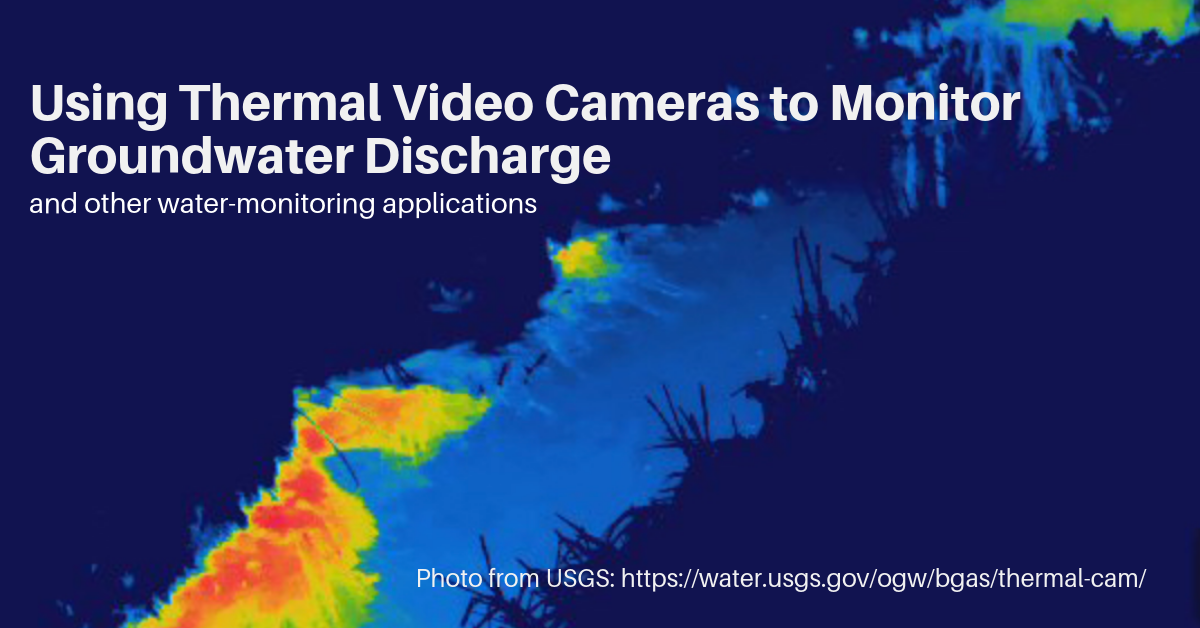
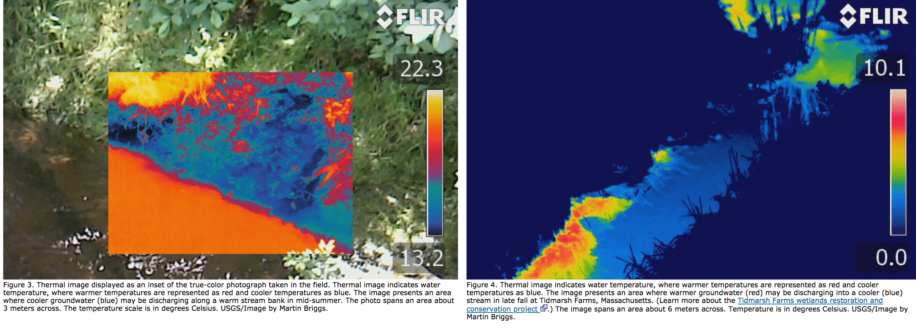
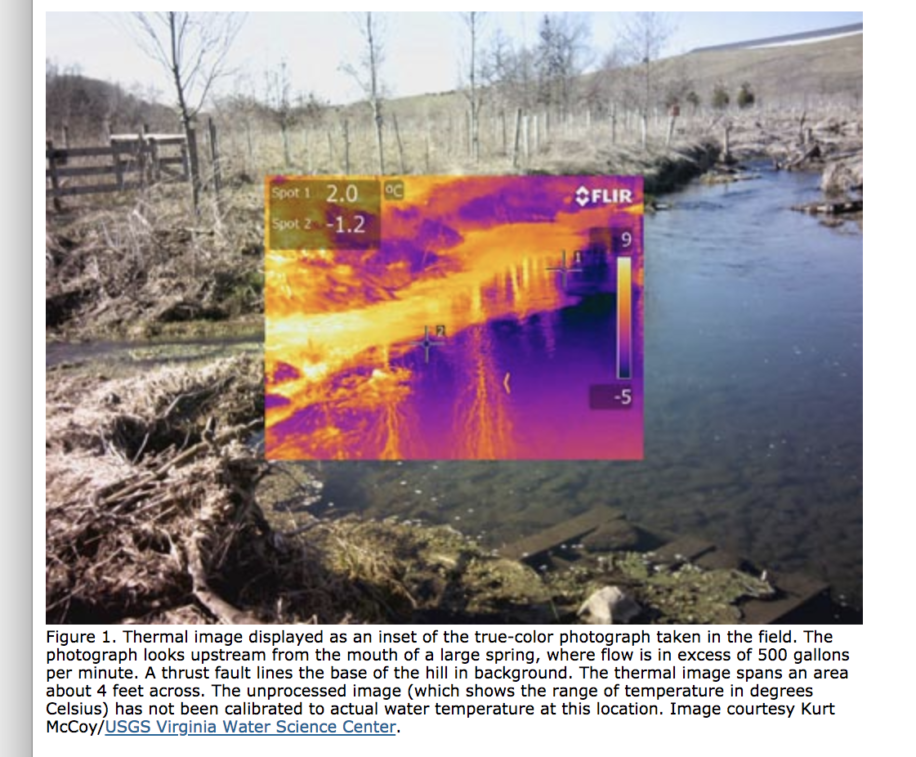
The U.S. Geological Survey (USGS) has pioneered the use of thermal imaging to track groundwater discharge points into rivers and streams. By detecting temperature anomalies, thermal cameras highlight where groundwater enters a stream, information invisible to the naked eye.
Recent USGS projects have expanded this research using handheld, drone-mounted, and fixed-location thermal imaging to map groundwater discharge zones across watersheds.
For example, in 2024 the USGS used thermal infrared imaging in the Upper Shawsheen River (Massachusetts) to identify preferential groundwater seeps along streambanks. These efforts improve groundwater–surface water models and guide water quality management in sensitive regions.

This video below from the Geological Survey of Arkansas includes a section on the use of thermal radiometry to track groundwater migration into streams and other surface water in the Ozarks. Scientists identified slow-moving groundwater seepage that could not have been observed without thermal radiometry. These insights help refine groundwater flow models and guide water quality management in sensitive regions like the Ozark aquifers.
These studies show how modern thermal imaging continues to refine our understanding of groundwater contributions to streams, with applications for environmental monitoring, aquifer health, and long-term watershed management.
Water Temperature Monitoring For Discharge Compliance & Fisheries Management
Thermal imaging has become an increasingly powerful tool for ensuring regulatory compliance and safeguarding fisheries management.
Here in Alabama, water temperature is more than just a number on a chart, it directly impacts fish health, local economies, and our way of life. Sport fishing alone generates millions in economic impact each year. If our rivers and lakes can’t sustain healthy fish populations, anglers will take their boats, gear, and tourism dollars somewhere else.
Sport fishing in Alabama has a huge economic impact.
That’s why monitoring discharge temperatures isn’t just about environmental stewardship, it’s about protecting Alabama’s outdoor recreation and tourism economy. Thermal cameras give us a proactive way to ensure these waters stay healthy for both people and fish.
Beyond sport fishing, thermal imaging has clear applications for aquaculture operations like catfish and freshwater shrimp farms. In this case, water temperature is directly tied to yield and profitability. Environmental agencies can also deploy fixed-location thermal cameras to monitor industrial discharge for compliance, while fisheries managers use them to track trout stream health and restore critical habitats.
Water Seepage from Mining Site Detected Using Thermal Camera
Thermal imaging is also valuable in industrial and mining applications, where water seepage and contamination risks can have serious environmental and financial impacts. For instance, researchers in Quebec used thermal cameras to measure groundwater seepage from an abandoned mining pit. The technology revealed water flows invisible through standard observation, supporting both environmental monitoring and remediation planning.

Closer to home, thermal imaging can be used at active mines, quarries, and industrial plants across the Southeast to detect seepage along containment ponds, monitor runoff that could impact nearby waterways, and ensure regulatory compliance.
In Alabama, where mining and quarrying remain major industries, thermal cameras could help operators identify leaks before they contaminate local streams or rivers, protecting both the environment and community health. For operators, this means fewer surprises, better environmental stewardship, and stronger community trust.
Thermal Cameras for Water System Management
Beyond research and environmental studies, utilities are putting thermal imaging to work in day-to-day operations. These cameras are not only useful for monitoring water itself, but also for keeping the critical systems that move water safe and efficient.
Thermal cameras can identify overheating components inside pumping and booster stations before they fail, spot electrical issues in control panels, and ensure motors and pumps are running within safe temperature ranges. By catching problems early, operators can avoid unplanned shutdowns, costly repairs, or service disruptions.
For water utilities in growing regions like Alabama, where demand is rising and infrastructure is aging, this kind of predictive maintenance is invaluable. It means fewer emergency callouts, better allocation of maintenance budgets, and more reliable service for communities.
In short, thermal imaging isn’t just about monitoring water flow, it’s about protecting the infrastructure and equipment that keep clean water moving to homes, businesses, and industries.
Why Thermal Cameras Matter for Water Management
Thermal cameras are proving to be a versatile tool in water monitoring applications, helping to:
At Vulcan Security Systems, we specialize in deploying industrial-grade thermal cameras like Mobotix to solve real-world safety and operational challenges. Whether it’s preventing theft at a scrap yard or monitoring environmental risks, we help businesses and agencies get more value from their video technology.
FAQ: Thermal Cameras for Water Monitoring
Do thermal cameras work for both environmental research and industrial applications?
Yes. Thermal imaging is used in academic research, regulatory monitoring, and industrial operations alike. The core benefit is early detection of heat differences that indicate water movement or quality changes.
Can thermal cameras detect water directly?
Not exactly. Thermal cameras detect temperature differences. In water monitoring, this often highlights cooler groundwater inflows or warmer discharges mixing into streams.
How do thermal cameras compare to traditional sensors?
Unlike single-point temperature sensors, thermal cameras provide a visual map of temperature differences across an entire area, giving much richer data.
Are thermal cameras only portable, or can they be fixed in place?
Both options exist. Researchers often use handheld thermal cameras in the field, while municipalities and industries benefit from fixed-location thermal cameras for continuous monitoring.
What does a system cost?
Professional thermal camera installations typically start at $2,500 per unit, with monitoring and service contracts available for long-term reliability.