Battery Storage Fire Risk: Why Thermal Video Monitoring Is Critical
Battery storage facilities face a fire risk that is fundamentally different from traditional industrial fire hazards. Once a battery fire starts, it is often too late to stop it. Thermal video monitoring helps detect dangerous heat buildup early, before a failure escalates into a toxic and uncontrollable event.
At Vulcan Security Systems, we design and support IP video systems for industrial and commercial environments where safety incidents, downtime, and liability have real consequences.
In this article, we explain why battery storage fires are so dangerous, why traditional fire detection often fails, and how thermal video monitoring plays a critical role in early detection and risk reduction.
Table of Contents
- Why Are Battery Storage Fires So Dangerous?
- Why Traditional Fire Detection Falls Short in Battery Storage Facilities
- How Thermal Video Monitoring Detects Battery Fire Risk Earlier
- Where Thermal Monitoring Is Already Being Used in Battery Storage
- What a Thermal Monitored Battery Storage System Looks Like
- Is Thermal Video Monitoring Worth the Investment?
Why Are Battery Storage Fires So Dangerous?
Battery storage fires are not like typical electrical or structural fires. They behave differently, spread faster, and are far harder to control once they begin.
Thermal runaway and chain reactions
Lithium ion batteries can experience a condition known as thermal runaway. When a single battery cell overheats, it triggers neighboring cells in a rapid chain reaction that can escalate in seconds, not minutes. Understanding how thermal sensors detect these heat signatures is the first step toward prevention.
In dense battery storage environments, this chain reaction creates compounding risk:
- A single overheated cell can trigger neighboring cells within seconds
- The reaction accelerates as more cells are affected
- Large battery arrays have more points of potential failure
- One incident can quickly become a facility-wide emergency
Toxic gases and extreme heat
Battery fires introduce hazards that go well beyond heat and flame. The combination of toxic gases, extreme temperatures, and suppression limitations makes them uniquely dangerous:
- Toxic and flammable gases are released into surrounding areas
- Heat levels quickly exceed what conventional suppression systems can handle
- Fire departments are often forced to isolate the area and let the fire burn out
- Nearby personnel face serious health risks even before flames are visible
Why early detection matters more than suppression
Once a battery fire reaches ignition, response options are limited. The most effective strategy is preventing ignition altogether. That makes early heat detection far more valuable than reacting to smoke or flames after the fact.
Why Traditional Fire Detection Falls Short in Battery Storage Facilities
Most fire detection systems were not designed with modern battery storage risks in mind. Each common approach has a meaningful limitation when applied to battery environments.
Smoke detection is reactive, not preventive
By the time a smoke detector activates, a battery has already failed. Smoke detection provides notification, not prevention. At that point:
- Heat levels are already elevated and dangerous
- Damage to the battery and surrounding equipment is likely underway
- Response time is compressed and intervention options are limited
Heat sensors lack visibility and context
Point based heat sensors monitor small, fixed areas and provide limited information. They can confirm a temperature threshold was crossed, but they cannot tell you:
- Where the problem originated within a large battery array
- How quickly conditions are changing
- Whether the issue is isolated or spreading to adjacent cells
This lack of visibility slows response and increases uncertainty when time is critical.
Sprinklers cannot stop lithium ion fires
Water based suppression may cool surrounding materials, but it does not stop thermal runaway inside a battery. In some situations, suppression efforts can even create additional hazards. For battery storage environments, detection needs to happen earlier and with more context than traditional systems can provide. Thermal cameras are specifically designed to fill that gap.
How Thermal Video Monitoring Detects Battery Fire Risk Earlier
Thermal video monitoring focuses on heat patterns rather than smoke or flames, allowing facilities to identify problems before a fire starts.
Continuous heat monitoring across wide areas
Thermal cameras monitor entire battery storage zones at once, giving operators visibility across the full battery array rather than a single point. They are designed to detect:
- Abnormal heat buildup across battery racks or storage zones
- Uneven charging behavior in specific cells or modules
- Isolated hot spots that indicate a failing or stressed battery
- Gradual temperature trends that precede sudden failure
Visual confirmation, not just alerts
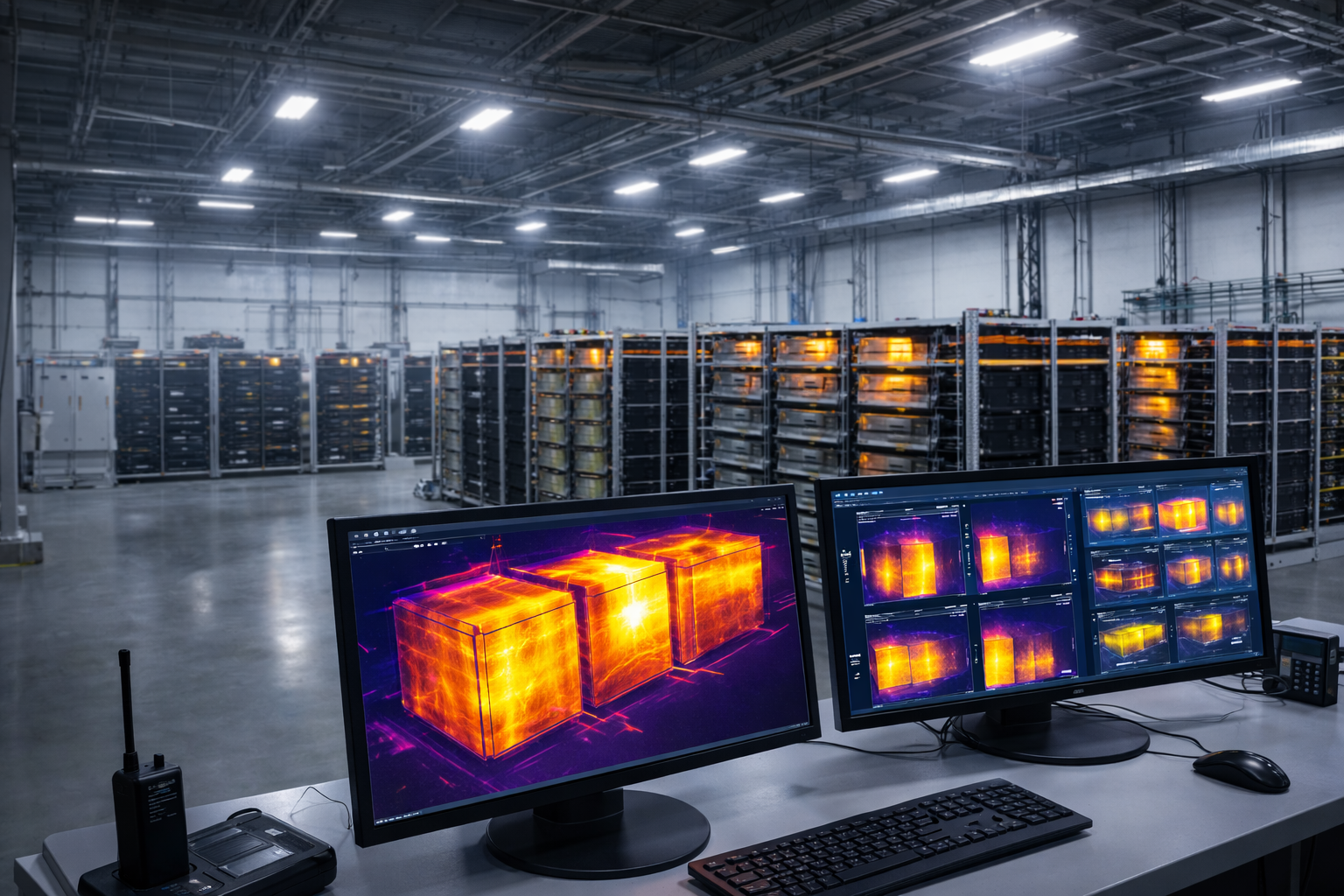
Thermal video provides visual context alongside temperature data. Operators can see exactly where heat is building and how quickly conditions are changing. This reduces false alarms and allows for more informed decisions rather than reactive guesswork.
Early alerts enable safer intervention
When heat anomalies are detected early, facilities have options that simply do not exist after ignition. Early detection allows teams to:
- Shut down affected charging systems before failure escalates
- Isolate the failing battery from the rest of the array
- Alert on-site staff with specific location and severity information
- Coordinate with emergency responders before the situation becomes uncontrollable
Where Thermal Monitoring Is Already Being Used in Battery Storage
Thermal monitoring is not theoretical. It is already being used in high risk battery environments across multiple industries.
Battery energy storage systems
Utility scale and commercial energy storage installations rely on large battery arrays to support grid stability and renewable energy. Constant oversight is essential in these environments because:
- High energy density creates compounding failure risk
- Large arrays mean a single cell failure can cascade quickly
- Around-the-clock operation limits manual inspection windows
Recycling and scrap facilities
Recycling centers often store large volumes of damaged or unknown condition batteries, placing them among the highest risk environments for battery related fires. These facilities face growing pressure from multiple directions:
- Higher battery fire rates compared to most other industries
- Increasing scrutiny from insurers around battery handling practices
- Regulatory attention on storage conditions and incident reporting
See how thermal cameras are already being used in recycling and waste management facilities.
Industrial charging and staging areas
Facilities that charge forklifts, heavy equipment, or electric fleets concentrate batteries in a single location, which is especially common in industrial environments where operations run around the clock. Several factors increase the risk in these areas:
- High charge cycle frequency accelerates heat buildup over time
- Close battery proximity increases the potential for cascading failure
- Limited overnight staffing reduces the speed of manual incident response
What a Thermal Monitored Battery Storage System Looks Like
An effective thermal monitoring setup is not just about installing cameras. It is about how those cameras are placed, configured, and supported over time.
Fixed thermal cameras covering battery zones
Thermal cameras are mounted to provide full, uninterrupted visibility of battery storage and charging areas. Industrial grade equipment is essential for reliability in harsh environments. Priority coverage areas typically include:
- Battery storage racks and shelving areas
- Active charging stations and staging zones
- Entry and exit points where batteries are moved or handled
Intelligent thresholds and alerts
Temperature baselines are established based on normal operating conditions. Alerts are triggered by abnormal patterns rather than fixed thresholds alone, which significantly reduces nuisance alarms and keeps operators focused on events that actually warrant attention.
Continuous monitoring and response workflows
Thermal alerts are reviewed by trained monitoring professionals who follow predefined escalation protocols. A typical response workflow looks like this:
- Alert is reviewed and assessed for severity and rate of change
- Monitoring staff determine whether conditions are stable or escalating
- Facility is notified with specific location and thermal data
- Emergency response is coordinated if conditions meet escalation thresholds
This is where many facilities move from simply recording data to actively reducing risk.
Is Thermal Video Monitoring Worth the Investment?
For many facilities, the cost of thermal monitoring is small compared to the cost of a single incident.
Comparing costs to potential losses
A battery related fire does not produce a single line item loss. The financial impact typically spans multiple categories:
- Equipment loss and replacement costs
- Structural facility damage
- Environmental cleanup and remediation
- Regulatory fines and compliance penalties
- Extended operational downtime
- Reduced or withdrawn insurance coverage after an incident
Insurance and risk management considerations
Insurers are paying closer attention to how battery storage risks are managed. Early detection systems that demonstrably reduce incident severity can play a meaningful role in broader risk mitigation strategies and ongoing coverage conversations.
When thermal monitoring makes sense and when it does not
Thermal monitoring is a strong fit for facilities with meaningful battery risk exposure:
- Multiple batteries stored, charged, or processed on site
- High charge cycle environments such as forklift fleets or EV charging
- Facilities with limited overnight staffing
- Locations with a prior history of heat-related incidents or near-misses
It is not the right solution for every environment. Single consumer device storage or low risk scenarios with constant on-site staffing may not justify the investment. Like any safety decision, it should be evaluated based on actual exposure and operational risk.
The Bottom Line on Battery Storage Fire Risk and Early Detection
Battery storage fires are fast moving, dangerous, and difficult to control. Detecting heat early is the most effective way to reduce risk before a failure becomes a fire.
Thermal video monitoring provides continuous visibility, early warning, and actionable insight that traditional fire detection systems cannot offer in battery storage environments.
If your facility stores, charges, or processes batteries, understanding your thermal risk exposure is the logical next step. As battery storage continues to expand across industries, proactive safety monitoring is becoming a necessity rather than an option.