How AI Surveillance Improves Workplace Safety for Businesses
AI video surveillance is changing how businesses keep people safe. Instead of relying on human guards or manual checks, modern AI cameras actively detect safety risks, from missing PPE to potential accidents, and alert supervisors instantly.
At Vulcan Security Systems, we’ve seen firsthand how intelligent video transforms safety culture for industrial, construction, and commercial clients.
This article explains exactly how AI surveillance improves workplace safety, with real-world examples from the field and practical insight on what this technology can do for you.
Table of Contents
- Why Traditional Safety Monitoring Falls Short
- What AI Surveillance Brings to Workplace Safety
- Real-World Applications of AI for Workplace Safety
- How AI Alerts and Automation Prevent Incidents
- Industry Examples: Construction, Industrial, and Commercial
- Overcoming Misconceptions About AI Surveillance
- The Future of AI-Driven Safety Monitoring
Why Traditional Safety Monitoring Falls Short
For decades, businesses have relied on two main tools to keep workplaces safe: security guards and standard video systems. The issue isn’t that these tools don’t work; it’s that they’re reactive.
Traditional cameras record footage but don’t interpret it. If a worker forgets to wear a hard hat or someone slips in a warehouse, no one knows until someone reviews the video later. The same is true for overnight shifts or weekends, when incidents often go unnoticed for hours.
Human monitoring helps, but even the most diligent manager can’t watch multiple screens 24/7. That’s where AI surveillance steps in; it allows cameras to not only see but also understand what’s happening in real time.
What AI Surveillance Brings to Workplace Safety
AI transforms cameras into intelligent monitoring systems trained to recognize safety risks automatically. Instead of passively recording, AI-equipped cameras can detect, analyze, and act fast.
Here’s how:
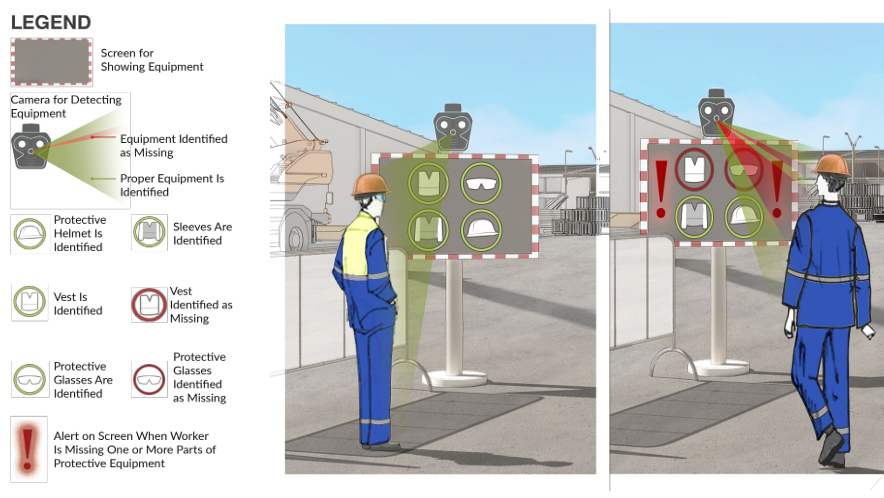
- PPE Detection: AI software recognizes whether workers are wearing hard hats, safety vests, gloves, or other protective gear. If someone is missing PPE, the system can automatically send an alert or even trigger a recorded warning message.
- Instant Alerts: AI doesn’t wait for human review. It sends instant notifications by email, text, or audio alert when it detects unsafe behavior.
- 24/7 Vigilance: Cameras don’t take breaks, making them ideal for multi-shift facilities or high-risk environments where continuous oversight is critical.
- Adaptive Learning: The system can be trained to recognize new hazards or procedures specific to your site, improving accuracy over time.
Real-World Applications of AI for Workplace Safety
AI surveillance has evolved beyond security; it’s now a frontline tool for safety management. Here are a few practical examples:
- Fall Detection: If someone slips or collapses, the system can recognize the motion and immediately alert staff or emergency responders.
- Audio Detection: Cameras can detect sudden loud noises or distress calls, even if the specific words aren’t recognized. When audio exceeds a certain threshold, the system flags it for review or triggers an alert.
- Restricted Area Monitoring: In one example, a site manager compared it to “the zoo’s bear enclosure.” If someone crosses into a restricted area, the AI detects it instantly and sends an alert.
- Machine and Equipment Monitoring: AI can identify when a machine is overheating, running longer than it should, or unexpectedly idle, helping prevent both accidents and downtime.
These applications go beyond compliance. They actively reduce risk by identifying unsafe conditions before they lead to injury.
How AI Alerts and Automation Prevent Incidents
The most valuable part of AI surveillance is its ability to act in real time.
Instead of waiting for someone to notice a problem, AI systems can issue automated alerts the moment they detect one. That could mean sending an email to a shift supervisor, activating a pre-recorded voice message on-site, or flagging a dashboard notification for review.
This automation changes the entire response timeline:
- Before an Incident: AI detects unsafe behavior or missing PPE and warns workers before something goes wrong.
- During an Incident: If someone falls, shouts, or enters a restricted area, the system immediately alerts personnel.
- After an Incident: High-resolution footage helps managers investigate what happened, why it occurred, and how to prevent it from happening again.
Industry Examples: Construction, Industrial, and Commercial
AI surveillance offers unique advantages across different work environments.
- Detects workers missing PPE or entering hazardous zones.
- Monitors after-hours trespassing or unsafe activity when no one is on-site.
Industrial & Manufacturing Facilities
- Identifies workers too close to moving equipment or machines that overheat.
- Detects prolonged machine inactivity or mechanical faults that could lead to safety hazards.
Commercial Properties & Warehouses
- Provides fall detection for lone or night-shift workers.
- Monitors pedestrian and forklift traffic for unsafe proximity or blocked aisles.
Across all these sectors, the principle is the same: AI surveillance adds a proactive safety layer that never turns off.
Overcoming Misconceptions About AI Surveillance
Like any new technology, AI surveillance comes with misconceptions. Let’s clear up the most common ones.
“AI surveillance is about watching people.”
Not quite. It’s about protecting people by automating hazard detection and ensuring compliance, without human bias or constant oversight.
“AI is too complex or expensive.”
Modern systems are surprisingly accessible. Vulcan’s proactive monitoring model includes hardware, AI software, and support at a predictable flat rate, no hidden fees or costly service calls.
“AI can’t adapt to our facility.”
AI software can be trained to recognize specific environments, workflows, and rules. As one expert explained, “If the technology’s not there yet, it will be soon; it’s just a matter of someone writing the software for it.”
The Future of AI-Driven Safety Monitoring
AI surveillance is still evolving, but its direction is clear. As software becomes more intelligent, cameras will be able to predict risks before they occur, not just detect them afterward.
In the near future, businesses can expect:
- Predictive analytics that forecast safety risks based on recurring patterns.
- Integrated dashboards that tie safety alerts to productivity metrics.
- AI models trained on millions of hours of industrial video, increasing precision across all industries.
According to Jason Maddox, “The sky is the limit when you talk about AI with eyes.” The more companies use it, the faster it improves.
Building Safer Workplaces with Smarter Surveillance
AI surveillance has turned security cameras into intelligent, tireless safety assistants. They detect missing PPE, monitor restricted zones, recognize distress signals, and alert managers before incidents escalate.
By combining real-time monitoring with automation, businesses gain continuous awareness that human teams alone can’t provide. The result: fewer accidents, faster response times, and stronger compliance, all without additional staffing costs.
If your facility runs multiple shifts, operates in hazardous conditions, or depends on manual monitoring, it’s time to explore how AI surveillance can make your workplace safer. Request a consultation with Vulcan Security Systems to learn how AI can protect your team 24/7.