Local vs Cloud-Based Security Systems: How to Choose the Right Fit for Your Business
The core difference between local and cloud-based video security is simple: local systems store footage onsite on a dedicated server, while cloud systems send it over the internet to remote servers. Both approaches have strengths and weaknesses in terms of cost, reliability, and accessibility, and the best choice depends on your business’s priorities.
This is a question nearly every business evaluating surveillance eventually faces. It’s an important decision, because it determines not just how your footage is stored, but how dependable, accessible, and cost-effective your system will be.
At Vulcan, we work primarily with industrial and commercial clients, and we’ve seen both models succeed when applied in the right context. From our experience, the most reliable option is actually dual redundancy, local systems paired with cloud backup, but we’ll always guide clients toward the setup that best fits their needs and budget.
In this guide, we’ll walk through the main differences between local and cloud-based video security, compare the pros and cons, and help you identify which option or combination makes the most sense for your site.
Table of Contents
- What’s the difference between local and cloud-based video security?
- Which system is more reliable?
- How do storage and costs compare?
- Which option is more secure?
- What about remote access?
- Should you consider a hybrid system?
- How to decide what’s best for your business
What’s the difference between local and cloud-based video security?
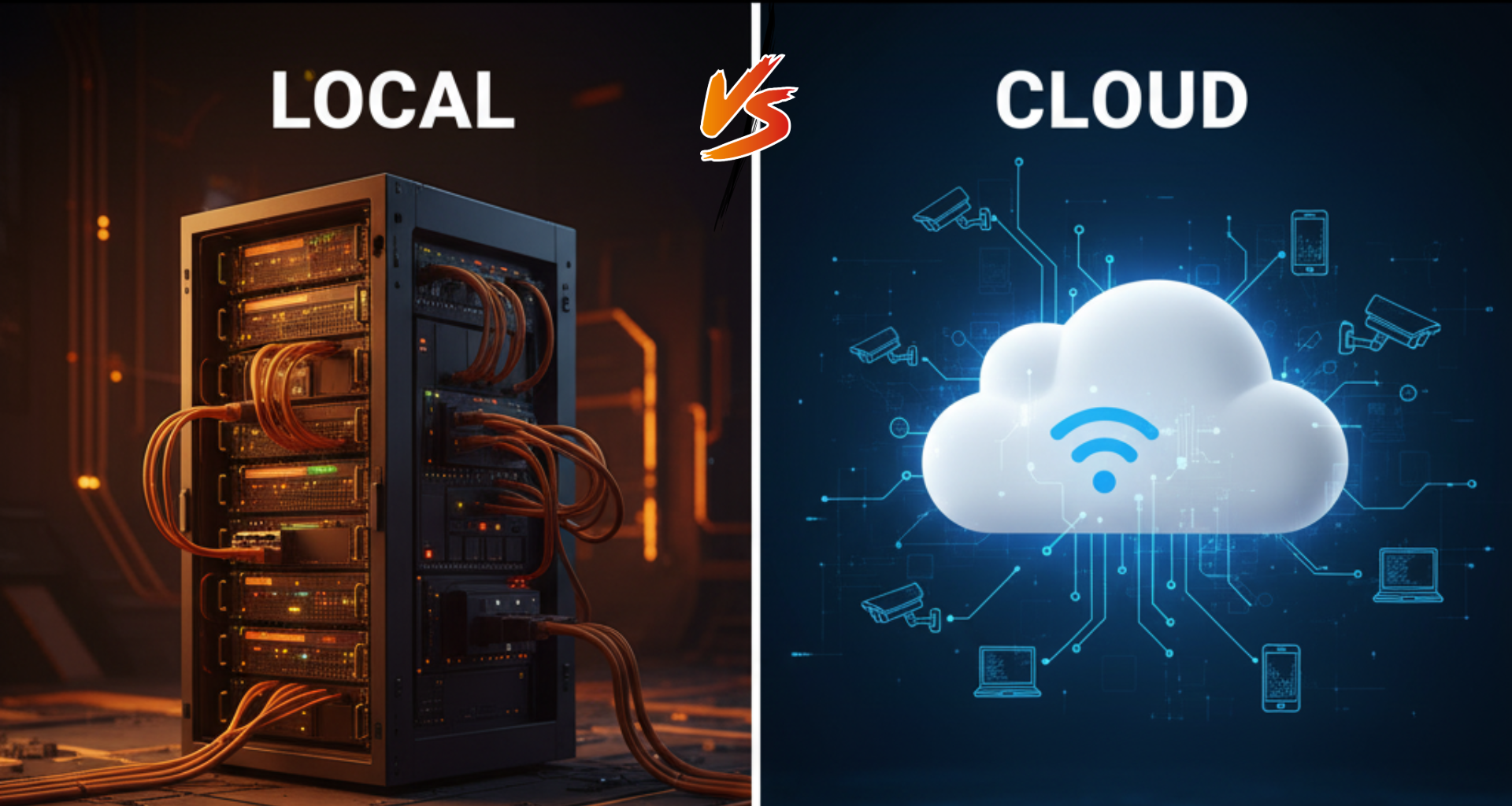
A local system records video directly to a server or storage device on your property. It doesn’t need an internet connection to continue recording.
A cloud-based system transmits video over the internet or a cellular signal to remote servers, where it is stored and accessed later.
The security industry as a whole has trended toward cloud adoption, mainly because of the convenience of remote viewing and management. However, this doesn’t automatically make it the best choice for every business. The real differences come into play when you look at reliability, cost, and security.
Which system is more reliable?
Reliability depends on one thing: what happens when your internet goes down.
- Local systems keep recording even if you lose internet or your network goes down. For most businesses, this is a major advantage.
- Cloud systems rely entirely on internet connectivity. If your connection fails or if your upload bandwidth can’t keep up, your cameras stop transmitting, and video is lost.
This is why many security integrators recommend redundancy: keeping a local server but also backing up to the cloud. It costs more, but it ensures you’re covered if one system fails.
|
System Type |
Strengths |
Weaknesses |
|
Local |
Records without internet; one-time hardware cost; highly configurable |
Limited remote access; risk if local server fails |
|
Cloud |
Easy remote access; vendor handles cybersecurity |
Stops recording if internet fails; monthly storage costs can grow quickly |
|
Hybrid |
Combines both reliability and accessibility; redundancy against outages |
Higher upfront and ongoing cost |
How do storage and costs compare?
This is where the biggest differences appear.
- Local storage is typically a one-time investment in hardware. At Vulcan, we tend to over-engineer local systems so they can handle high-resolution video, multiple frames per second, and weeks of retention, all without ongoing costs beyond maintenance.
- Cloud storage is billed monthly and scales with how much video you want to retain. Higher resolution and longer retention equal higher costs. For businesses needing weeks or months of stored video, these costs can add up quickly.
If you’re watching your budget closely, local systems usually deliver more value over time.
Which option is more secure?
Security can be debated from both sides.
- Local systems give you direct control. When paired with proactive service monitoring (like Vulcan’s service contracts), you can have constant data integrity checks to ensure video is always available when needed.
- Cloud systems are typically encrypted and protected by the vendor’s cybersecurity infrastructure. This can reduce the risk of data loss if you don’t have strong internal monitoring in place.
Ultimately, the deciding factor is who is maintaining the system. A poorly managed local system can be less secure than a well-run cloud system, and vice versa.
What about remote access?
This is one area where cloud systems just barely have the edge.
- Cloud systems make it simple to view video from anywhere, assuming you have strong internet on both ends.
- Local systems can also provide remote access, but it usually requires more setup. At Vulcan, we use remote connectivity tools that allow you to log into the onsite PC as if you were sitting right there. The footage is then streamed locally, reducing the need to push heavy video files through limited upload bandwidth.
In both cases, your internet upload speed at the site is the limiting factor. If it’s slow, remote access will be choppy no matter which system you use.
Should you consider a hybrid system?
For businesses where downtime is unacceptable, a hybrid solution of local storage backed up to the cloud is often the best approach.
Hybrid systems provide:
- Redundancy if one system fails
- Local reliability during outages
- Cloud convenience for remote access
The drawback is cost. Hybrid systems are more expensive to set up and maintain, but for businesses where missing a single event could cost tens of thousands of dollars, the investment is often worth it.
How to decide what’s best for your business
There isn’t a one-size-fits-all answer. Your decision should be based on budget, risk tolerance, and operational needs.
|
Option |
Best For |
Trade-offs |
|
Local |
Long-term cost efficiency, greater control, and reliability during outages |
Limited remote access, risk if the server fails |
|
Cloud |
Easy access from anywhere, vendor-managed security, and scalability |
Dependent on the internet, rising subscription costs |
|
Hybrid |
Mission-critical sites needing full redundancy, peace of mind |
Higher upfront and ongoing costs |
The Bigger Picture: Making the Right Call on Local vs Cloud
Local systems are generally less expensive and more reliable, cloud systems are more convenient, and hybrid systems provide the strongest protection at a higher cost. The key factors to weigh are internet reliability, storage costs, and how critical it is that your cameras never miss a moment.
Choosing between local and cloud-based security isn’t just a technical decision; it’s a business one. The right choice can save you money, reduce liability, and give you confidence that your cameras will be there when you need them most.
At Vulcan, we design security systems tailored to each site’s needs, whether local, cloud, or hybrid. If you’re evaluating options, we can help you determine the setup that makes the most sense for your business.