Thermal Camera Options Guide: What We Recommend to Protect Your Business
Your thermal camera options come down to one real choice: single lens or dual lens. A single lens, thermal only camera detects heat. A dual lens or multi module camera detects heat and shows you what caused it. That difference matters more than the brand or model you choose.
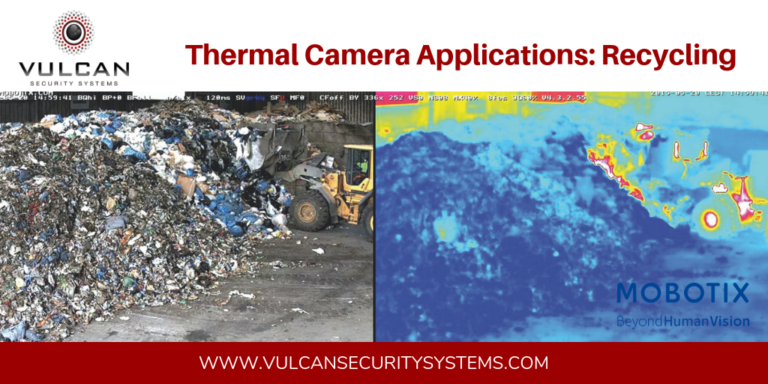
Here is the scenario we hear constantly. An alert fires at 2am. The owner pulls up the footage expecting to see an intruder. Instead they see an orange blob that could be a person, a raccoon, or a warm exhaust vent. The camera worked. It just could not say what it saw.
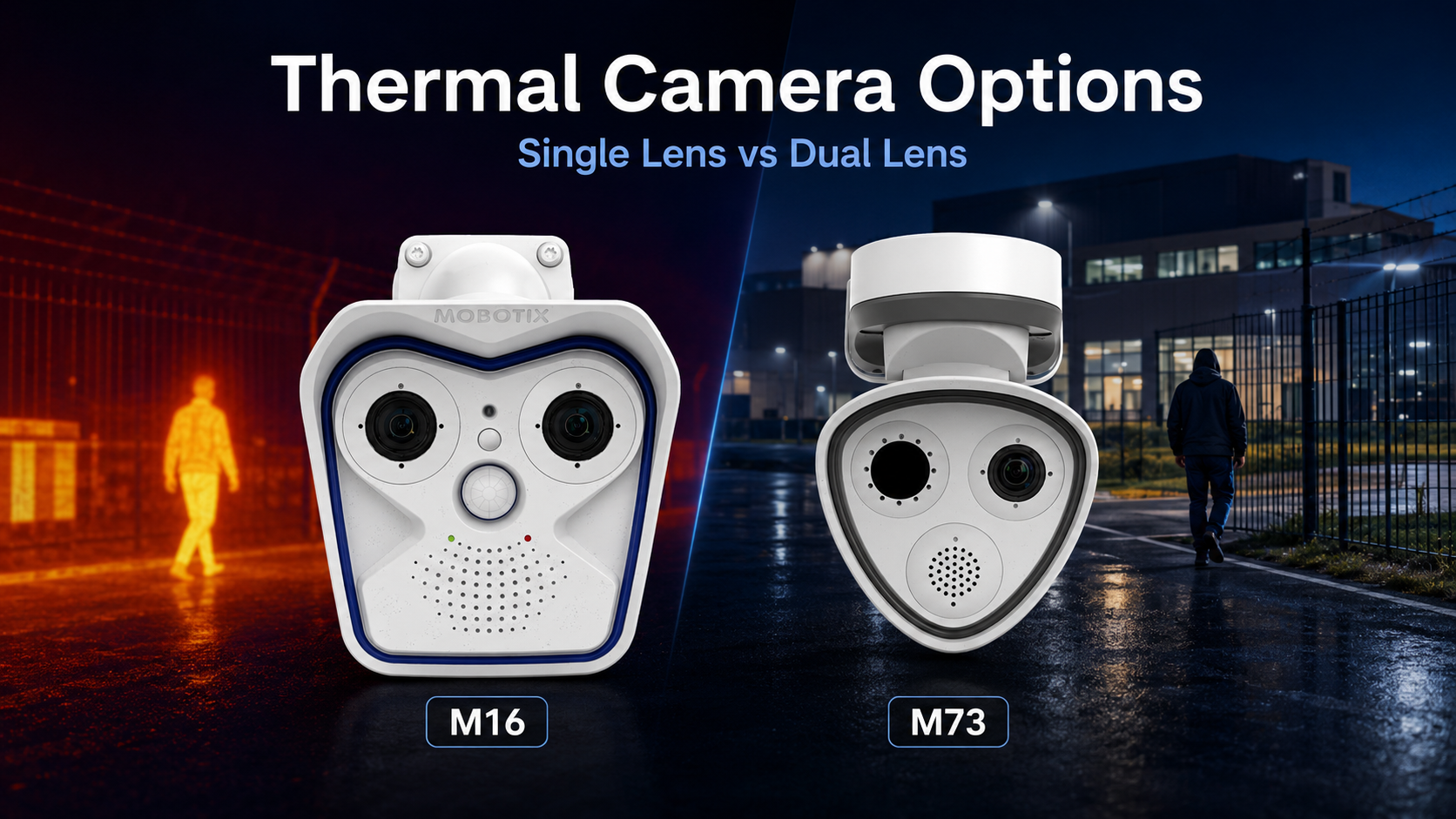
We install Mobotix almost exclusively, including the M16 and M73 thermal models, so we are not a neutral reviewer comparing every brand on the market. That bias is worth naming upfront. Even so, the module lesson in this guide applies no matter which manufacturer you choose.
In this guide, we break down single, dual, and triple module thermal cameras, compare the Mobotix M16 and M73 directly, and help you decide what your property actually needs.
- The Problem With Thermal Only Cameras
- Why Dual Lens Changes the Equation
- Your Thermal Camera Options: Single, Dual, and Triple Module Setups
- M16 vs M73: How Mobotix’s Thermal Cameras Compare
- What Thermal Cameras Cost
- How to Choose the Right Thermal Camera Option
- FAQ
The Problem With Thermal Only Cameras
A single lens thermal camera has one job: detect heat in total darkness, fog, or smoke. It does that job well. Thermal sensors read temperature, not light, so darkness and weather do not slow them down.
The trouble starts the moment you need to act on an alert. A thermal only feed shows a heat map, not a photo. Every warm shape looks roughly like every other warm shape, whether it is a person, an animal, or a hot exhaust vent.
For a homeowner, that ambiguity is a minor annoyance. For a business deciding in real time whether to call the police or dispatch a guard, it is a real problem. The camera gives you a warning it cannot explain. A vague alert also costs money: dispatching a guard or calling the police to confirm a non-event burns time and goodwill, especially if it keeps happening.
Why Dual Lens Changes the Equation
This is the part every buyer should understand, regardless of brand. The real value is not the thermal sensor alone. It comes from pairing that sensor with a visible light sensor, either in the same body or mounted alongside it.
With dual lens coverage, the sequence changes completely. The thermal sensor triggers the alert. The visible sensor, often boosted by infrared or white light at night, shows what is actually there: a person at the fence, a parked vehicle, or nothing worth worrying about.
This pairing matters even more in environments like battery storage facilities, where a thermal anomaly can mean an early stage fire. Knowing exactly what is overheating, a battery module versus a forklift exhaust, determines how fast and how appropriately a team responds.
Put simply, if you are buying thermal, get dual lens coverage too, whether in one camera or two. A thermal only camera without a second set of eyes is doing half the job.
Your Thermal Camera Options: Single, Dual, and Triple Module Setups
Thermal cameras generally come in three setups.
- Single module. Thermal sensor only. Good for automated triggers like lights or alarms where no one reviews footage live. The least expensive option and the least informative.
- Dual module. Thermal sensor paired with a day and night visible sensor in one housing. Functionally, this gives you the coverage of two separate cameras without doubling your mounting hardware or wiring. This is the baseline we recommend for almost every commercial site, since it covers detection and identification in a single unit.
- Triple module. Thermal, visible, and a third function, such as an infrared illuminator, white light, or an added environmental sensor. Best for sites with unusual lighting needs or room to grow.
M16 vs M73: How Mobotix’s Thermal Cameras Compare
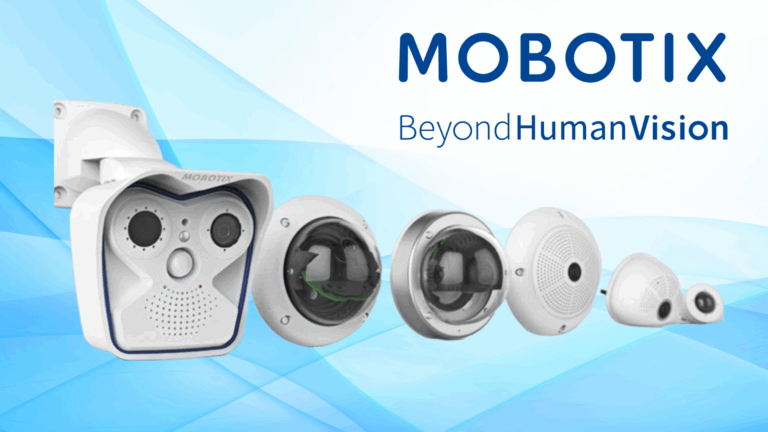
Inside the Mobotix lineup, the M16 and M73 are the two thermal camera options we install most. Both have earned a strong reputation in the field, but they solve slightly different problems.
The M16 is the established option. It ships as a fixed dual sensor unit, thermal and visible built into one body, with a 50mK thermal sensor and a choice of lens angles, typically 45, 25, or 17 degrees, so you can match the field of view to your site.
You pick your configuration at purchase, and it stays that way for the camera’s full life. For straightforward perimeter and yard coverage, that simplicity works in your favor.
The M73 is the newer platform, and it centers on modularity. The body holds up to three interchangeable modules, so you can run thermal, visible, and a third module such as an IR illuminator or white light.
You can also swap or upgrade modules later instead of replacing the whole camera. Some M73 thermal modules support Thermal Radiometry, which can trigger an alarm at an absolute temperature threshold, from negative 40 degrees Celsius up to 550 degrees Celsius, useful for catching equipment overheating before it becomes a fire. That flexibility comes at a higher price than the M16.
| M16 | M73 | |
|---|---|---|
| Modules | Two, fixed at purchase (thermal and visible) | Up to three, interchangeable |
| Best fit | Straightforward perimeter and yard coverage | Sites that want flexibility or a third function now or later |
| Upgrade path | Replace the camera | Swap or add individual modules |
| Relative cost | Lower | Higher |
We will not tell you the M73 is automatically better. For many properties, the M16’s fixed two sensor design covers everything the site needs at a lower cost.
The M73 earns its higher price when a site needs a third module, faces harsh lighting, or wants room to grow. The right model depends on your site, not on which one is newer.
What Thermal Cameras Cost
Thermal camera options are a real investment. A dual lens Mobotix unit typically costs twelve thousand to thirteen thousand dollars once installed, depending on lens configuration, mounting, and whether you add a third module.
That number surprises people comparing it to a standard IP camera. For example, one thermal camera covering a dark perimeter often replaces several standard cameras plus supplemental lighting, and it keeps working through fog, smoke, and total darkness where ordinary cameras cannot see. Because Mobotix processes analytics on the camera itself, you also avoid extra server hardware and ongoing software licensing costs that some competing systems require.
For sites where a missed event creates real financial or safety risk, that cost compares well against the cost of the incident it prevents. It also holds up well against the ongoing cost of staffing a guard for the same coverage, since the camera does not need a paycheck, a break, or a shift change. See our video security system pricing guide for the full breakdown.
How to Choose the Right Thermal Camera Option
A few questions narrow your thermal camera options down fast. Does your team need to identify what triggered an alert, or just know something happened? For nearly every commercial site, identification matters, which makes dual lens the floor, not an upgrade.
Does your site have unusual lighting, long throw distances, or a future need for illumination? That points toward the M73. Is this a straightforward perimeter with predictable conditions? The M16 likely covers it without paying for modularity you will not use. If you are outfitting a multi building campus, the right mix often blends both models, M16 units on simpler perimeters and M73 units on zones that need more flexibility.
Still not sure? That is what a site walk solves. We look at your property, talk through what you need to detect and identify, and recommend the option that fits, not the most expensive one on the shelf. For more on where thermal fits across industrial, commercial, and environmental use cases, see our guide on sensor equipped thermal camera applications, and for the platform behind these cameras, read why Vulcan uses Mobotix for reliable, long term security.
FAQ
What is the difference between the Mobotix M16 and M73 thermal cameras?
The M16 is a fixed, dual sensor camera with thermal and visible imaging built into one body. The M73 is modular, supporting up to three interchangeable modules, with the ability to swap them later. The M73 costs more and flexes more. The M16 costs less and covers most straightforward jobs.
Do I need a dual lens thermal camera, or is a thermal only camera enough?
For most commercial and industrial sites, dual lens is the right baseline. A thermal only camera tells you heat was detected, not what caused it. Pairing thermal with a visible sensor, in one camera or two, lets you see and confirm the trigger.
What thermal camera options does Vulcan recommend?
For most commercial sites, we recommend the Mobotix M16 or M73, both dual lens at minimum. The M16 fits straightforward perimeters. The M73 fits sites that need a third module or room to grow.
How much does a thermal security camera cost?
A dual lens thermal camera typically costs between twelve thousand and thirteen thousand dollars installed, depending on configuration, lens angle, and mounting.
Can I add modules to a thermal camera after it is installed?
With the Mobotix M73, yes. Its modular design supports adding or swapping modules after installation. The M16 does not, since its sensors are fixed at purchase.
Does Vulcan only install Mobotix thermal cameras?
Yes, and we are upfront about that. We chose Mobotix for its durability, on camera processing, and long service life. The module guidance in this article applies regardless of brand, but our installations and recommendations are built around the Mobotix lineup of thermal camera options.