What AI Cameras Can Actually Detect: Real-World Business Use Cases
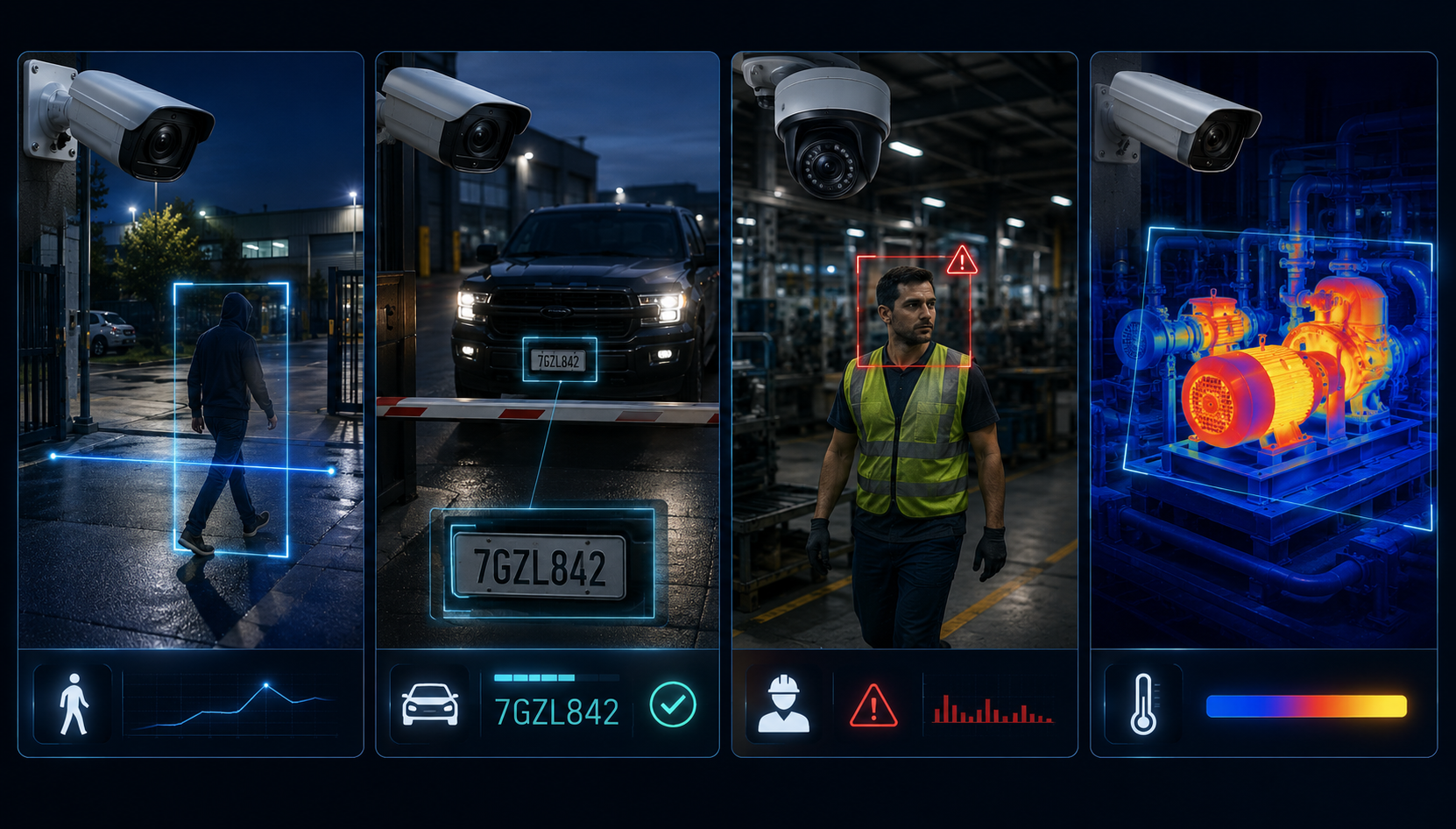
What can AI cameras detect in commercial and industrial settings? People, vehicles, license plates, PPE compliance, loitering, crowd density, heat anomalies, and more. These are not future capabilities. They are running in active deployments across retail, manufacturing, logistics, and security applications right now.
The challenge for buyers is that the marketing around AI cameras is noisy. Vendors overpromise. Skeptics underestimate. The reality is more practical than either extreme. AI video analytics work reliably for specific, well-defined detection tasks when camera placement and conditions support them. Performance varies significantly by application and environment.
Vulcan Security Systems designs and installs AI-powered IP video systems for commercial and industrial clients. We configure these systems daily and see firsthand what performs and what does not. We have an interest in the products we sell and aim to give buyers an honest picture of both.
This guide covers the major AI detection capabilities available in commercial-grade systems today, what each one does, where it works well, and what affects real-world performance.
Table of Contents
- Person and Vehicle Detection
- License Plate Recognition
- Perimeter Intrusion Detection
- Loitering Detection
- Crowd Density and Occupancy Monitoring
- PPE Compliance Detection
- Thermal and Heat Anomaly Detection
- Object Left Behind and Removed
- Facial Recognition
- What These Systems Cannot Do
- Choosing the Right Capabilities for Your Business
- Frequently Asked Questions
Person and Vehicle Detection
Person and vehicle detection is the most widely deployed AI camera capability and one of the most reliable. The system identifies human figures or vehicles in real time. Specifically, it distinguishes them from motion caused by wind, animals, or changing light conditions.
This is used to:
- Eliminate nuisance alerts from motion-triggered systems
- Flag people or vehicles entering restricted areas after hours
- Monitor occupancy in access-controlled zones
- Log traffic patterns in parking areas and loading docks
Performance is strong in most commercial environments with proper camera positioning and adequate lighting.
License Plate Recognition
License plate recognition, or LPR, reads vehicle plates from live video and logs or acts on the data in real time. Dedicated LPR cameras are purpose-built for this application, with hardware and software calibrated for vehicles moving at entry speeds under variable lighting conditions.
Common uses in commercial settings include:
- Automated gate access for authorized vehicles
- Arrival and departure logging at facility entrances
- Flagging stolen or unauthorized vehicles
- Providing documented records for post-incident investigations
- Parking enforcement in commercial lots
Accuracy depends on camera angle, distance, vehicle speed, and lighting. Standard cameras can capture plates in ideal conditions. However, dedicated LPR hardware outperforms them significantly in high-demand scenarios.
Perimeter Intrusion Detection
Perimeter intrusion detection uses virtual tripwires and zone monitoring to alert when a person or vehicle crosses a defined boundary. It removes the need for continuous human monitoring by flagging events for review instead. Learn more about how intrusion detection systems stop break-ins before they happen.
This capability is used most often in:
- Industrial facilities and warehouses after hours
- Construction sites where equipment theft is common
- Data centers and secure storage areas
- Utilities and critical infrastructure
Loitering Detection
Loitering detection goes beyond identifying presence. It tracks whether the same person remains in a defined area longer than a configured time threshold. In other words, the system monitors behavior over time rather than just detecting a single event.
Applications include ATMs and kiosks, parking lots and building entrances where lingering is associated with risk, and restricted areas where extended unauthorized presence warrants a response. Live monitoring services add a verified response layer on top of these alerts.
Crowd Density and Occupancy Monitoring
AI cameras can estimate the number of people in a defined area and generate alerts when a threshold is exceeded. This is deployed in retail queue management, public venue safety compliance, and healthcare waiting area oversight.
The capability became widely adopted during the public health restrictions of 2020 and 2021. It has continued in settings where crowd density has real operational or safety implications.
PPE Compliance Detection
AI cameras can detect whether workers in a frame are wearing required personal protective equipment. This includes hard hats, safety vests, safety glasses, and gloves. Violations trigger alerts and are logged for audit purposes.
This is deployed in manufacturing, construction, oil and gas, chemical processing, and warehousing. Detection accuracy is strongest with good lighting and clear sightlines to workers at reasonable distances. For more on this capability, see how AI surveillance improves workplace safety for businesses.
Thermal and Heat Anomaly Detection
Thermal cameras detect infrared radiation rather than visible light, which makes them useful in applications where standard cameras fall short. They are a distinct product category, selected for specific applications where heat detection or low-light performance is the primary requirement.
In commercial and industrial environments, thermal cameras are used to:
- Detect overheating equipment before a failure occurs
- Identify dangerous heat buildup in battery storage areas
- Monitor perimeters and detect intrusions in complete darkness
- Provide after-hours coverage without supplemental lighting
Object Left Behind and Removed
Some AI platforms detect when an object appears in a location where it should not be, or disappears from a location where it should remain. Use cases include abandoned item detection in secure environments, merchandise removal in retail settings, and asset monitoring in high-value storage areas.
Performance varies depending on object size, background complexity, and camera angle. This capability is worth evaluating carefully for your specific application before committing to it.
Facial Recognition
Facial recognition is technically available in AI camera platforms and is used in some commercial access control and identity verification applications. It also carries significant legal complexity.
Several U.S. states and municipalities have enacted restrictions on commercial facial recognition use. Any organization evaluating this capability should involve legal counsel before deployment. Vulcan does not include facial recognition in standard system designs without a specific legal and operational review.
What These Systems Cannot Do
AI video analytics cannot interpret intent with certainty, guarantee detection in all conditions, or eliminate the need for thoughtful system design. Inadequate lighting, poor camera placement, low resolution, and obstructions will degrade any of these capabilities.
Vendor claims should always be evaluated against real-world performance data. Where possible, test the system in conditions similar to your actual environment before full deployment. See practical AI video analytics applications for a grounded look at what is working in the field today.
Choosing the Right Capabilities for Your Business
The most effective AI video systems are designed around a clear problem definition. What needs to be detected? Where does it happen? What should happen when it is? Starting with those questions produces better outcomes than starting with a feature list.
Vulcan offers free on-site assessments to help businesses identify the right combination of AI capabilities for their specific environment. Contact us to get started.
Frequently Asked Questions
Can AI cameras detect weapons?
Some platforms offer weapons detection, but real-world performance in commercial environments varies widely. This capability requires careful evaluation and should not be treated as a substitute for security protocols and trained personnel.
Do all AI camera capabilities require cloud processing?
No. Many modern AI cameras process analytics locally through edge computing, meaning detection happens on the device without sending footage to an external server. This reduces latency and addresses some data privacy concerns.
How do false alert rates compare between AI and standard motion detection?
Well-configured AI systems produce significantly fewer false alerts than motion-based systems because they distinguish between relevant events and irrelevant movement. However, poorly configured AI systems can still generate high volumes of nuisance alerts. Setup and tuning matter considerably.