Why Security Cameras Fail at Night and How to Fix It
Most security cameras do not fail at night because of one thing. They fail because of a combination of short infrared range, small sensors, poor lens quality, and placement that was never designed for low-light conditions. Understanding which problem you have determines what the fix actually is.
We install and service commercial video security systems, so we see this pattern regularly. The right solution is not always the same camera or the same technology. Some properties need better hardware. Some need thermal. Some just need the cameras pointed correctly.
This post walks through the most common failure points and what actually addresses each one.
Why Most Security Cameras Struggle at Night
Before getting into specific failure points, it helps to understand how night vision cameras work. Most use infrared illuminators, built-in IR LEDs that flood a scene with infrared light the human eye cannot see. The camera sensor captures reflected IR light, similar to how a standard camera captures visible light during the day. That means the quality of the illuminator, the sensitivity of the sensor, and the distance between the camera and the subject all directly affect what the footage actually shows.
The Most Common Reasons Security Cameras Fail at Night
Infrared Range That Does Not Match the Space
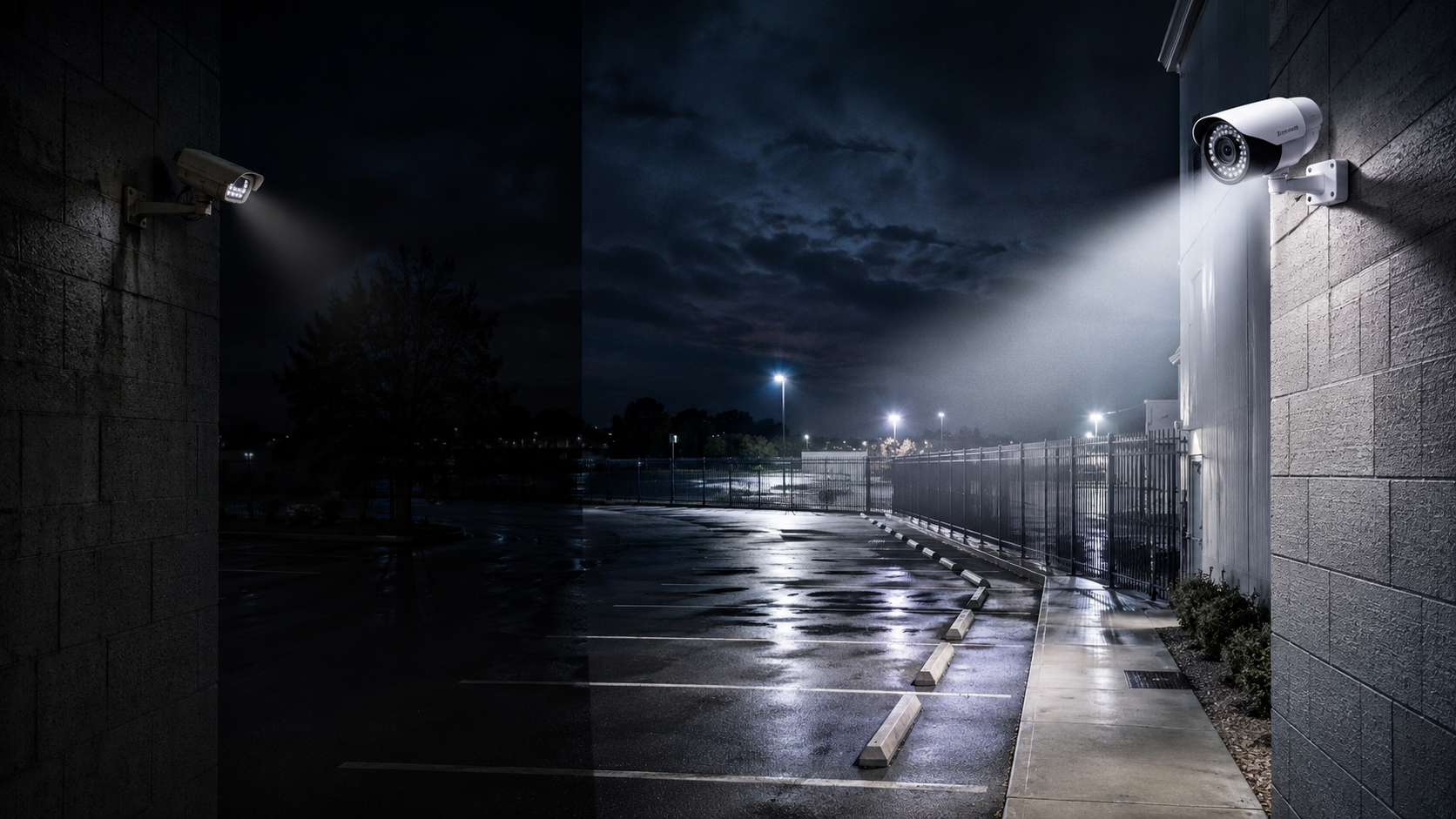
Most budget cameras have IR ranges of 30 to 50 feet. The parking lot, loading dock, or exterior perimeter they are covering is often two or three times that distance. Anything outside the IR cone is simply dark. The camera is recording, but it is recording nothing useful.
This is one of the most common and most preventable reasons security cameras fail at night. It comes down to hardware selection not matching the actual coverage requirement.
Image Sensors Too Small to Gather Light
Sensor size is one of the most important factors in low-light performance and one of the first things cut to reduce cost. A larger sensor gathers more light, which produces a cleaner image at night even with the same IR illumination. A small sensor, even with a functional IR throw, produces a grainy or washed-out image because it cannot collect enough light to resolve detail.
On paper, two cameras may have the same resolution spec. In practice, at night, one will be dramatically better than the other based on sensor quality alone.
Lens Aperture and Video Compression
Aperture controls how much light passes through the lens. A wider aperture collects more light and performs better at night. Many cameras are tuned for daytime sharpness and use a narrower aperture that produces sharper daytime footage but darker nighttime images. Layered on top of that, heavy video compression strips out the fine detail that already-limited night footage contains. The result is footage that technically shows motion but cannot identify what caused it.
Placement That Was Not Designed for Low Light
This is often overlooked because it is not a hardware failure. A camera aimed toward a light source will blow out the frame. A camera mounted at the wrong angle will cause IR glare off a reflective surface like glass or wet pavement. A camera placed too far from the target area will have an IR throw that falls short.
A significant portion of night performance failures are installation problems, not equipment problems. Better hardware in the same position often will not fix them. We cover how placement affects overall coverage in more depth in why fewer cameras can mean better coverage.
How to Fix Each Problem
Match IR Throw to the Actual Coverage Distance
Measure the distance the camera needs to cover before selecting the hardware. Match the IR range to that distance with margin included. For large exterior zones, cameras with longer IR throw or supplemental IR illuminators can extend usable nighttime coverage significantly. The coverage area drives the hardware spec, not the other way around.
Upgrade to a Larger, More Sensitive Sensor
Higher-quality cameras use larger sensors with better signal processing and, in many cases, wider aperture lenses. The difference in night performance between a well-engineered camera and a budget one is not subtle. If existing cameras are producing grainy or dark footage at night, sensor quality is usually the place to start. Upgrading resolution alone will not fix a low-light sensitivity problem.
Consider Thermal for the Right Scenarios
Thermal cameras detect heat emitted by objects rather than reflected light. They require no illumination at all and can detect a person or vehicle in complete darkness, through fog, and in some cases through light smoke. They are also used for early fire detection, identifying heat anomalies before a fire actually develops.
Thermal is not universally better than infrared. It is a different tool with a different job. Thermal cameras typically have lower resolution and cannot reliably identify a face or read a license plate. They are excellent for detection at long range and in challenging visibility conditions. Infrared cameras are better for identification, detail capture, and producing footage that holds up as evidence. We explain how the two technologies work together in AI and thermal cameras: stopping break-ins and fires early.
Use AI Analytics to Reduce Missed Detections
AI-powered video analytics improve what a camera catches at night independently of the hardware. By classifying objects intelligently — distinguishing a person from a shadow, a vehicle from a tree branch moving in the wind — analytics reduce false negatives and false positives simultaneously. They can trigger alerts on specific behaviors, flag objects that linger in restricted zones, and surface events that motion-based detection would miss entirely.
This layer of intelligence makes a meaningful difference at night when image quality is at its lowest and the margin for missed detections is at its highest.
Fix Placement Before Replacing Hardware
A physical walkthrough of coverage at night should happen before any hardware upgrade decision is made. Check angles, distances, reflective surfaces, and competing light sources. A mid-range camera in the right position usually outperforms a high-end camera aimed wrong. Correcting placement is often the lowest-cost fix with the highest impact.
When to Use Thermal vs. Infrared
This is one of the most common questions in commercial security, and the answer depends on what the camera needs to do.
- Use infrared when you need to identify faces, read license plates, capture usable evidentiary detail, cover indoor spaces, or work within a tighter hardware budget.
- Use thermal when you need long-range perimeter detection, reliable performance in fog or smoke, heat anomaly monitoring for fire risk, or detection in environments where IR illumination is not practical.
- Use both when the property has exterior perimeters where detection range is the priority and entry points or high-value zones where identification matters.
For most serious commercial installations, the right answer is a combination. Thermal cameras cover the outer perimeter and wide exterior zones where the goal is detecting presence at distance. Infrared cameras cover entries, driveways, parking areas close to the building, and any location where footage might need to support an investigation or insurance claim.
What to Look for When Assessing a Night Failure
A few questions help identify where the real problem is before spending money on a fix.
- Is the footage dark or completely black? The IR range probably does not match the distance.
- Is the footage visible but grainy or unclear? Sensor quality or compression is the likely cause.
- Is one part of the frame blown out? There is a light source interference or IR glare issue.
- Is the image quality fine but events are being missed? That is an analytics or placement problem, not a hardware one.
- Does performance change in fog, rain, or smoke? That is a scenario where thermal becomes relevant.
Knowing which question applies to your property determines which fix is worth spending money on.
The Bottom Line
Security cameras fail at night for specific, diagnosable reasons. Infrared and thermal cameras are different tools that serve different purposes, and the right combination depends on the property, the environment, and what the footage needs to accomplish. Getting that assessment right before buying hardware is what separates a system that actually works from one that just looks like it does.
If your cameras are underperforming at night, Vulcan will walk the property, identify what is actually failing, and give you a straight answer on the fix, whether that is hardware, placement, analytics, or all three.
Frequently Asked Questions
Are thermal cameras better than infrared cameras for night vision?
Neither is universally better. They serve different functions. Thermal detects heat in complete darkness or fog but has lower resolution. Infrared cameras are better for identification and detail. Most serious commercial properties benefit from using both in different zones.
Why does my security camera show a dark or grainy image at night?
Usually the cause is a short infrared range, a small image sensor, or placement that creates IR glare or misses the target area. Each has a different fix, and identifying which one applies determines whether the solution is hardware, installation, or both.
Can AI analytics improve night camera performance?
Yes. AI analytics improve detection accuracy at night by classifying motion intelligently and reducing both false positives and missed events. They add a meaningful detection layer on top of the hardware and work independently of camera resolution or IR performance.
How far can a security camera see at night?
It depends on the camera’s IR range. Budget cameras typically cover 30 to 50 feet. Higher-end cameras with longer IR or supplemental illuminators can reach 100 feet or more. Thermal cameras can detect heat at much longer distances, though without the resolution needed for identification.
What is the main advantage of thermal cameras over infrared at night?
Thermal cameras need no illumination at all, work in fog and light smoke, and can detect heat anomalies including early fire signatures. The trade-off is lower image resolution, which makes them better suited for detection and perimeter coverage than for identification.