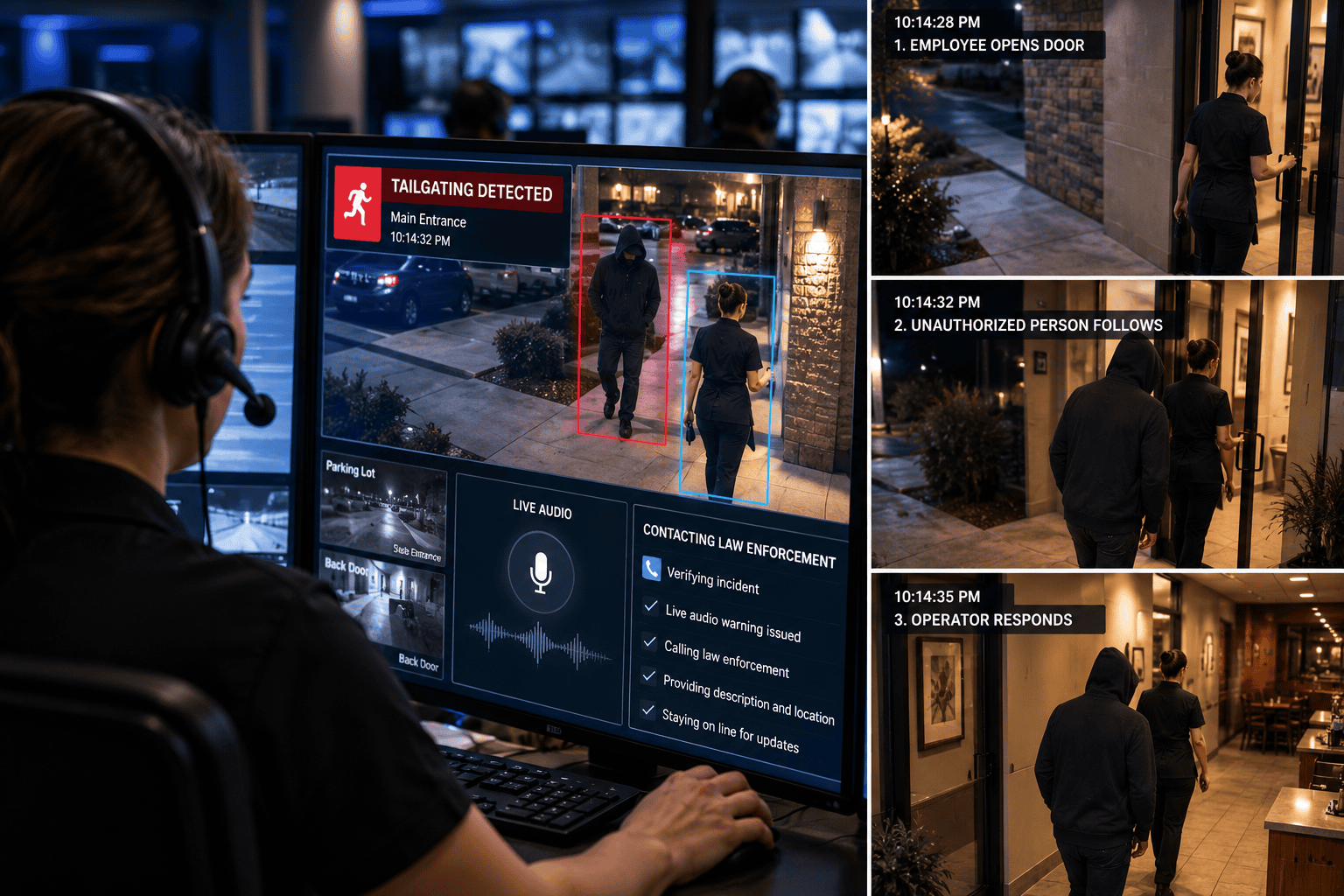
How Monitoring Centers Respond During a Forced Re-Entry Situation
A forced re-entry happens fast. Someone waits near a door, an employee opens it to leave or lock up, and the person pushes their way in before the door closes. The entire incident can unfold in seconds, which means the response has to be just as fast. That response is where a monitoring center, not just a camera, actually determines the outcome.
Vulcan Security Systems operates 24/7 live monitoring for businesses across Alabama, and forced re-entry situations are exactly the kind of event our monitoring center is built to catch and act on in real time. This article walks through what a forced re-entry actually looks like, how detection identifies it, and the specific steps a monitoring operator takes once an alert fires.
What Forced Re-Entry Looks Like in Practice
Forced re-entry, sometimes called a push-in, typically targets the moment an employee is opening or locking a door rather than a fully secured building. Someone positions themselves near the entrance, often out of direct sightline, and waits for the door to open. When it does, they force their way in behind or alongside the employee before the door can be secured again.
This threat is different from a standard break-in because it does not require defeating a lock or an alarm system. It relies entirely on timing and an employee’s normal, necessary movement through a door.
How AI Detection Identifies the Moment It’s Happening
AI-powered surveillance is what makes real-time detection of this kind of event possible. A door-held-open alert flags when an entrance stays unlocked or ajar longer than expected. Tailgating detection identifies when a second person enters directly behind an authorized employee. Motion detection outside normal operating hours flags activity near an entrance when the building should otherwise be empty. Any one of these triggers is enough to put the moment in front of a live operator immediately, rather than waiting for someone to notice it on a recording the next day.
What a Monitoring Operator Actually Does, Step by Step
Verifying the Alert
The moment an alert fires, the operator pulls up the live camera feed to confirm what is actually happening. This step takes only seconds and determines everything that follows, since a false alarm and a real forced re-entry require very different responses.
Live Audio Intervention
If the situation looks like an active intrusion, the operator can speak directly through the camera’s speaker, informing whoever is on the property that they are being watched, recorded, and that police are being contacted. This single step interrupts a large share of incidents before they escalate further, because most people attempting a forced re-entry are counting on not being seen or heard in real time.
Contacting Law Enforcement
At the same time as or immediately following audio intervention, the operator contacts local law enforcement with a live description of the person, their location on the property, and what is currently happening. This is a materially faster and more accurate report than a 911 call placed by an employee who is still in the middle of the incident.
Staying on the Line With Employees
Where two-way communication is available, the operator can stay connected with employees on site, providing real-time guidance, confirming their safety, and relaying updates to responding officers until the situation is resolved.
Why Speed Matters More Than Almost Anything Else
A forced re-entry situation is measured in seconds, not minutes. A camera system that only records footage for later review offers no advantage in that window. The value of a monitoring center comes entirely from compressing the time between detection and action down to something close to instant, which is not possible without a live operator already watching when the alert fires. We cover the broader case for why after-hours protection needs this kind of real-time response in why after-hours security requires a different approach.
What to Ask When Evaluating a Monitoring Provider
- What is the average time between an alert firing and an operator verifying it.
- Does the provider offer live two-way audio, not just recorded video.
- Who contacts law enforcement, and how quickly does that happen after verification.
- Is monitoring truly 24/7, including holidays and off-peak overnight hours.
- Can the system detect tailgating and door-held-open events specifically, not just general motion.
The Response Plan Matters as Much as the Camera
A forced re-entry is not stopped by the fact that a camera exists. It is stopped, or made much less dangerous, by what happens in the seconds after detection. A monitoring center that verifies, intervenes with live audio, and contacts law enforcement immediately turns a camera system from a passive witness into an active layer of protection.
Vulcan’s monitoring center is built to respond to exactly this kind of situation in real time. We will show you what that response actually looks like for your property.
Frequently Asked Questions
What is a forced re-entry or push-in situation?
It is when someone waits near a door for an employee to open it, then pushes their way inside before the door can be closed and secured, rather than breaking in through a locked entrance.
How does a monitoring center know a forced re-entry is happening in real time?
AI detection features like door-held-open alerts and tailgating detection flag the event the moment it starts, sending a live alert to a monitoring operator who is already watching the camera feed.
Can a monitoring operator actually stop an incident from happening?
An operator cannot physically intervene, but live audio warnings delivered through the camera speaker interrupt a large share of incidents, since most offenders are counting on acting unseen and unheard.
How fast can police actually be contacted during one of these events?
A monitoring operator can contact law enforcement within seconds of verifying an alert, providing a live description and location that is typically faster and more precise than a call placed during the incident itself.
Does this kind of monitoring work for small businesses, not just large facilities?
Yes. Forced re-entry risk applies to any business with employees who open, close, or exit through a door alone, regardless of size, and monitoring can be scaled to fit a single entrance or a full property.