
Video Security ROI: Can a Security Camera Replace a Security Guard?
Video security ROI has finally hit the point where the right system can pay for itself in months, not years. Smart cameras and event-based monitoring now work together so well that businesses across Central Alabama are replacing full-time security guards, cutting payroll, and getting better coverage at the same time. The math is simple. The technology is proven. The savings are real.
In this article, you will see exactly how a properly designed commercial video surveillance system reduces or eliminates security staffing costs, lowers incidents of theft and vandalism, and builds documentation that protects you from bogus injury claims. We will use real client numbers and direct quotes along the way.
Table of Contents
- The Real Cost of a Security Guard
- PGP Operating Case Study: Real ROI in the Field
- Optical vs Thermal Camera Sensors
- MOBOTIX M16: Dual Sensor Cameras
- How Event-Based Remote Monitoring Works
- The Invisible Force Field
- System Design, Equipment Quality, and Long-Term ROI
- Designing a Video Security System That Pays for Itself
- Frequently Asked Questions
The Real Cost of a Security Guard
Whether you outsource through a third-party agency or staff guards directly, human security guards are one of the largest recurring line items on a commercial security budget. For a single facility that needs overnight and weekend coverage, $81,000 per year per guard is a conservative minimum.
Here is the breakdown using minimum staffing rates:
- Coverage from 6 p.m. to 6 a.m., five weeknights, plus 24-hour coverage Saturday and Sunday
- 12 hours x 5 days x $15 per hour = $900
- 24 hours x 2 days x $15 per hour = $720
- $1,620 per week x 52 weeks = $81,000 per year
That figure assumes a single guard, paid at the low end of the market, with no benefits or overtime built in. For a large yard, multi-building campus, or any facility with several access points, one set of eyes is rarely enough. Even a diligent guard cannot watch every gate, dock, and blind corner at the same time. A theft incident on a guarded shift is exactly what pushed one Vulcan client to look for a better answer.
PGP Operating Case Study: Real ROI in the Field
“We thought we would get better coverage and better security protection using a camera-based system,” explained Mike Bretzke, General Superintendent at PGP Operating, LLC. “The cost savings have been amazing. It moved the needle and it wasn’t a small installation. The installation will more than pay for itself within a year in cost savings compared to what we were paying for security before.”
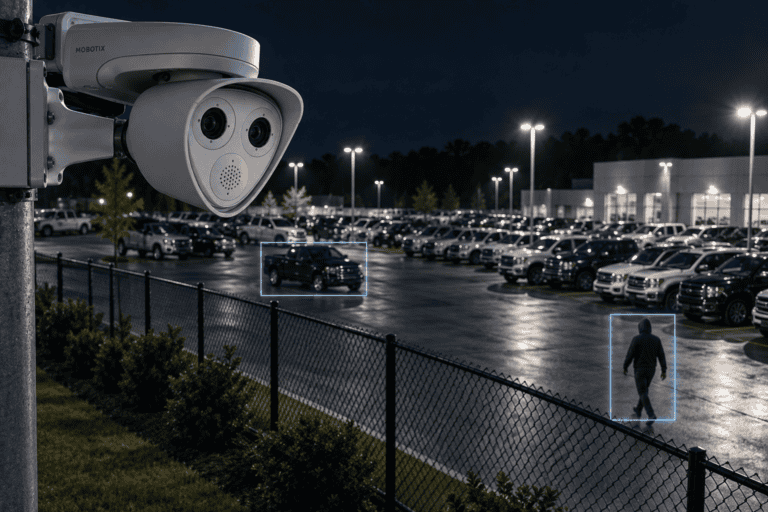
PGP needed reliable coverage of a large lot with uneven lighting, so we recommended the MOBOTIX M16 dual-sensor camera paired with our event-based monitoring service. Read the full PGP Operating, LLC case study for the deployment details and the cost savings PGP captured in year one.
Optical vs Thermal Camera Sensors
Choosing the right sensor type is one of the biggest factors in whether a system delivers real ROI or just stacks up false alarms. Optical cameras capture images visually, the way the human eye does. Quality MOBOTIX models start at 6MP HD resolution as a baseline. The catch with optical-only cameras: they need light. Low-lit yards, large storage areas, or any property with shadows from trees, wildlife, or weather create blind spots and false alerts.
A real example from a Vulcan client:
“One of our commercial properties sits in the flight path for the Birmingham airport. After it rained, water would sometimes pool on certain areas of the roof. When planes flew over, the cameras would detect a little red dot reflecting in the pool, and that would generate alerts at the monitoring station all night long,” said Jason Maddox, president of Vulcan Security Systems.
Thermal cameras solve that problem. They read the heat signature given off by people, vehicles, wildlife, and even hot spots in stored materials or equipment. They do not need ambient light to work.
“Thermals see perfectly, just as well at pitch black night as in bright sunshine,” Maddox said.
Why thermal cameras win on ROI:
- They capture clean images in low-light and pitch-black conditions
- They reduce false alarms tied to lighting, weather, and shadows
- They detect intruders through visual camouflage, since heat cannot be hidden
- They cover larger areas with fewer cameras, which lowers total system cost
For a deeper look at where thermal cameras pay off across industries, see our guide to thermal camera applications for industrial and commercial sites.
MOBOTIX M16: Dual Sensor Cameras
The MOBOTIX M16 line gives you both sensor types in a single camera unit, which is unique in the market.
“MOBOTIX is the only company I know of that offers dual thermal and optical sensors in the same camera,” Maddox said. “The M16 gives you the best of both worlds in a single camera.”
What that looks like in practice:
- The thermal channel detects heat-based events in total darkness, fog, and harsh weather
- The optical channel captures HD-quality imagery suitable for identification, prosecution, and insurance documentation
- One device, one mount, one cable run, instead of two separate cameras side by side
- On-camera smart processing reduces network load and cuts storage costs
Combine the M16 with event-based monitoring and the entire security workflow becomes semi-automated. Operators only get pulled in when the system flags an event worth a human review. Learn more about the MOBOTIX platform we standardize on, and why we trust it for high-stakes commercial deployments.
How Event-Based Remote Monitoring Works
MOBOTIX cameras are programmable. Each camera, and each defined zone within a camera’s field of view, can be set to trigger an alert based on motion, heat, or other rules. When something hits a defined trigger, an automated email lands at the monitoring station with snapshot images attached.
From there, the operator follows a decision tree built around your facility:
- Wildlife or weather: logged and dismissed. The client never gets bothered.
- Possible trespasser: the operator pulls up the live feed and uses voice-down audio to issue a warning.
- Active intrusion: 911 is called immediately, and the operator stays on the line with police using the live feed.
A simple audio warning is usually enough to send a trespasser running. Reading off the color of a jacket or car works wonders. If the situation escalates, the monitoring operator can describe whether the intruder is armed, where they are headed, and whether they have already left the property by the time officers arrive.
This is the part of the system that does the work a guard cannot. One operator can watch dozens of properties at once, only acting when the cameras flag something real. That is leverage human staffing simply cannot match.
The Invisible Force Field
“Once word gets out that there are ‘eyes’ on the premises, shenanigans tend to stop,” Maddox said. “The bad guys will usually pick an easier target.”
That is the deterrent value of a visible, professional, intelligently designed video security system. PGP Operating has lived it.
“We’ve had no incidents since installation,” said Mike Bretzke at PGP Operating, LLC.
The invisible force field is what no security guard can offer at scale: the constant, recorded, AI-assisted, voice-enabled presence of a system that never gets tired, never takes a break, and never gets distracted.
System Design, Equipment Quality, and Long-Term ROI
ROI is not just about the camera. A system delivers real returns when it is designed correctly from the start. That requires:
- The right system design for your facility, traffic patterns, and risk profile
- Durable, professional-grade hardware with a long service life
- Clean installation and proper programming of zones and triggers
- Routine functionality testing so the system is working when you actually need it
Vulcan Security Systems standardizes on MOBOTIX for hardware. The cameras are made in Germany, run on non-proprietary software, and pass strict quality control before they ship. Non-proprietary software matters because it gives you flexibility on integrations and protects you from vendor lock-in down the road.
“A $50,000 system can pay for itself in 10 months if you can eliminate the need for security guards,” Maddox said.
The savings keep going past the guard line item. The same camera footage:
- Provides documentation that defeats bogus slip-and-fall claims
- Supports workers’ comp investigations and reduces fraudulent claims
- Gives prosecutors clean evidence when theft or vandalism does occur
- Helps insurance carriers price your policy more favorably
Designing a Video Security System That Pays for Itself
“It’s a no-brainer,” Maddox said, “if you use good equipment and technology and choose a good partner for your installation and monitoring.”
The path to real video security ROI is straightforward:
- Map the actual risk areas of your property and the assets you most need to protect
- Pick the right sensor mix (optical, thermal, or dual-sensor M16) for each area
- Define the zones and triggers that matter, and ignore the noise that does not
- Pair the system with event-based monitoring so events get filtered before they reach you
- Test, tune, and adjust as your operations and threats change
If you are budgeting for security in the coming year, run the math. Most facilities that swap a full-time guard for a properly designed smart camera system see payback inside 12 months and savings every year after. Contact Vulcan Security Systems for a no-pressure walkthrough of your property and a system design built around the ROI of your specific use case.
Frequently Asked Questions
How much does a security guard cost per year?
For a single facility with overnight and weekend coverage at minimum staffing rates, expect a baseline around $81,000 per year per guard before benefits or overtime. Larger sites usually need multiple guards per shift, which scales the cost quickly.
Can a security camera really replace a security guard?
For most commercial use cases, yes. A properly designed video security system using smart cameras and event-based monitoring covers more area with fewer blind spots than a single human guard, with no fatigue, no sick days, and no shift gaps.
What is event-based monitoring?
Event-based monitoring is a semi-automated service where cameras trigger alerts on specific events (motion in a defined zone, a heat signature, or another rule) and a remote operator only reviews live footage when an event is flagged. It is faster, cheaper, and more accurate than continuous human monitoring.
What is a thermal camera, and why does it matter for ROI?
A thermal camera reads heat signatures instead of visible light, so it works in total darkness, in rain, and through visual camouflage. That eliminates entire categories of false alarms, which lowers operating costs and improves response time on real events.
How long until a video security system pays for itself?
According to Vulcan Security Systems president Jason Maddox, a $50,000 system can pay for itself in roughly 10 months when it eliminates the need for a full-time security guard. Actual payback depends on system size, the number of guards replaced, and reductions in theft, vandalism, and fraudulent claims.
What happens if police need to be called?
The monitoring station calls 911 and stays on the line. Because the operator is watching the live feed, they can describe whether the intruder is armed, where they are headed, and whether they have already left the scene before officers arrive.
Does a video security system reduce false alarm fatigue?
Yes, especially with thermal or dual-sensor cameras. Thermal sensors do not trigger on shadows, leaves, headlight reflections, or rain pooling, which are common false alarm sources for optical-only systems. Pair that with event-based monitoring and the noise drops dramatically.