Alabama Crime Trends Industrial Companies Should Know
Alabama’s property crime rate grew 16.2 percent in 2024, a year when the national average fell 9 percent. That is a significant divergence. For industrial companies, commercial property operators, and facility managers across Alabama, understanding what is driving this crime trend and what early warning signs look like on the ground is a practical security question, not an abstract one.
Most industrial facilities do not experience major incidents very often. The problem is that when they do, the conditions that made it possible were usually present for some time beforehand. Perimeter testing, after-hours activity near access points, and copper or metal theft from adjacent properties all precede larger incidents. Most facilities have no system in place to detect them.
Vulcan Security Systems designs and installs AI-powered IP video systems for industrial and commercial facilities across Alabama. We work in the environments these crime trends affect directly, and we have a real stake in how well our clients are protected. We also want to give industrial operators a clear picture of what the data shows and where AI detection adds genuine value.
In this article, we cover what Alabama crime data shows for property and industrial crime, the specific patterns that put industrial companies at risk, and how AI cameras detect early warning signs before an incident escalates.
In This Article
- What Alabama Crime Data Shows
- Why Industrial Facilities Are a Specific Target
- Early Warning Signs AI Cameras Can Detect
- The Response Layer Matters as Much as Detection
- What This Means for Alabama Industrial Operators
- Frequently Asked Questions
What Alabama Crime Data Shows
The most significant headline in recent Alabama crime data is directional. Violent crime in Alabama fell 13.7 percent in 2024. Property crime moved the other direction, growing 16.2 percent compared to a 9 percent decrease in the national average. That gap, Alabama property crime rising while the country moved the other way, is the context industrial operators need to be thinking in.
Breaking down the property crime categories shows where the exposure is concentrated:
- Larceny-theft: Represents 73.4 percent of all property crimes in Alabama. This is the broadest category and includes theft of equipment, materials, tools, and vehicles from commercial and industrial properties.
- Burglary: Accounts for 15.6 percent of property crimes. Alabama’s burglary rate of 456 per 100,000 residents remains above national averages, with commercial properties a consistent target.
- Motor vehicle theft: At 11.1 percent of property crimes, and rising. Commercial vehicles, fleet trucks, and work vehicles are commonly targeted, particularly when stored in large open lots overnight.
Alabama law also specifically addresses secondary metal recycling, which reflects the volume of copper wire and scrap metal theft in the state. This category of theft targets industrial facilities, utilities, and construction sites. It has enough presence in Alabama that the legislature enacted dedicated criminal statutes to address it.
Why Industrial Facilities Are a Specific Target
General crime statistics tell part of the story. Industrial facilities face a specific vulnerability profile that differs from retail or residential targets.
- High-value materials stored outdoors: Copper wiring, aluminum, steel, catalytic converters, and construction materials are high-value targets often stored in large open yards with minimal after-hours oversight.
- Predictable after-hours emptiness: Industrial facilities typically operate on defined shifts. Once production ends, the site is empty and quiet. Repeat offenders observe operating patterns before acting.
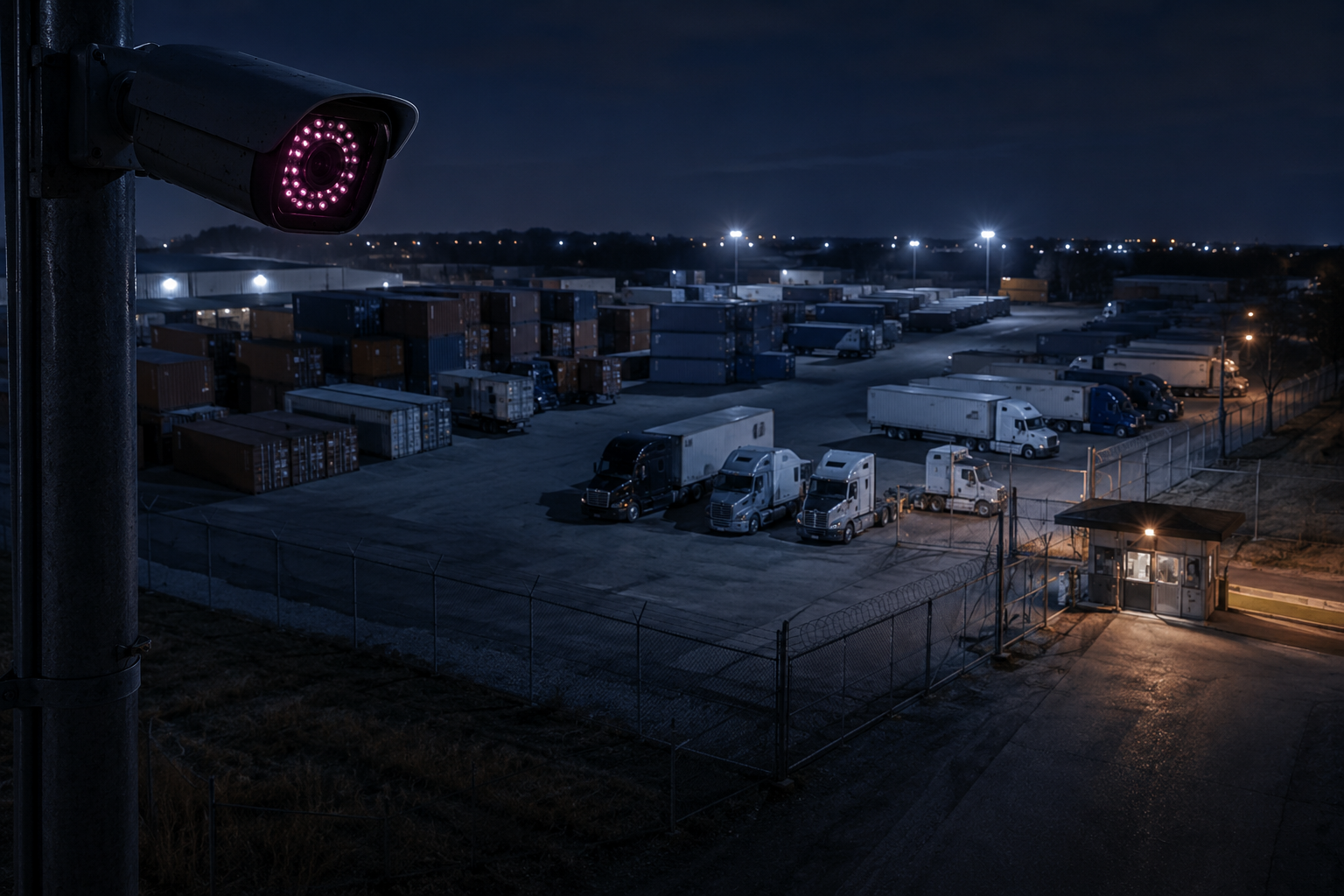
- Large perimeters with multiple access points: Warehouses, fabrication yards, and distribution facilities often have extensive fencing perimeters with numerous gates that are difficult to monitor consistently.
- Equipment and vehicle staging areas: Forklifts, trailers, generators, and heavy equipment staged outdoors overnight represent significant replacement cost exposure and are targeted by organized theft operations.
- Long recovery timelines: When industrial equipment or materials are stolen, replacement timelines can mean days or weeks of operational disruption. This compounds the direct cost of the loss.
Early Warning Signs AI Cameras Can Detect
Most significant incidents at industrial facilities do not happen without warning. There are observable behaviors that typically precede a targeted theft or burglary. The problem is that detecting them requires someone to be watching, and after-hours surveillance at industrial scale is not practically achievable through human staffing alone.
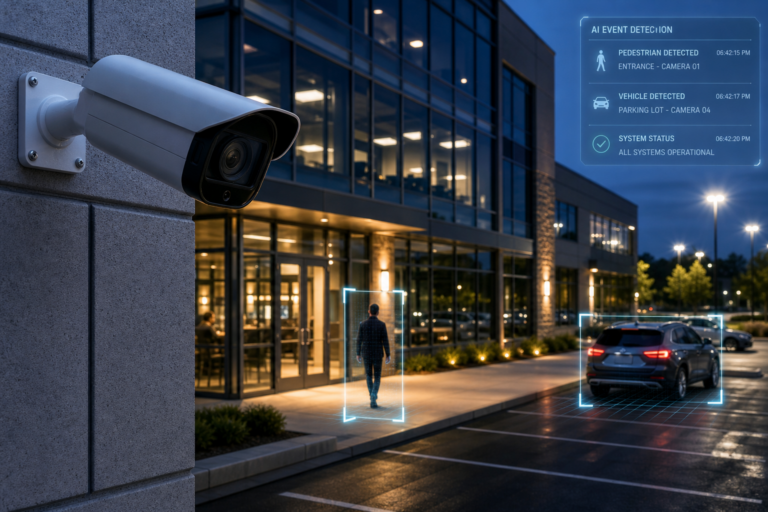
AI-powered video monitoring detects these behaviors automatically and in real time:
- Perimeter testing: Individuals approaching fencing, examining access points, or walking the perimeter at unusual hours without authorization. AI cameras flag this activity as it happens rather than capturing it for later review.
- Slow vehicle passes: Vehicles making repeated passes along facility perimeters or stopping near access points late at night are a documented precursor to industrial theft. License plate recognition and loitering detection identify this pattern.
- Unauthorized entry after hours: AI-based perimeter intrusion detection triggers alerts when a person or vehicle crosses a defined virtual boundary, allowing a monitored response before the incident escalates.
- Gathering near entry points: Groups of individuals gathering near access points or loading areas outside of operational hours. Crowd detection and zone monitoring identify this in real time.
- Copper or metal removal from adjacent areas: In facilities near active theft corridors, visible removal of materials from neighboring properties or utility infrastructure can signal a broader pattern of activity in the area.
The Response Layer Matters as Much as Detection
Detecting an early warning sign only creates value if there is a response. AI video analytics generate the alert. What happens next determines whether that alert prevents an incident or simply documents it.
In actively monitored systems, an alert triggers a response from a trained operator who can:
- Observe and document the activity in real time
- Issue a live audio warning through on-site speakers, informing anyone present they are being monitored
- Contact law enforcement with verified information about the activity and the individuals involved
- Notify the facility owner or security manager immediately
This combination of detection and response changes the risk calculus for anyone targeting an industrial facility. A site that appears empty but responds audibly and summons law enforcement with accurate descriptions is a very different target than one that is simply recording.
What This Means for Alabama Industrial Operators
The combination of rising property crime, an industrial target profile, and AI detection capabilities points toward a straightforward security posture for facilities that take this seriously: active monitoring with AI-enhanced detection, covering the perimeter and access points where early warning patterns are most likely to appear.
That does not mean high-cost infrastructure for every facility. It means designing the system around the specific risk profile of the property, the materials or equipment stored on site, the operating schedule, and the history of incidents or near-misses in the area.
Vulcan conducts free on-site assessments for industrial and commercial facilities across Alabama. If you want to understand your current exposure and where AI video monitoring fits, contact us to schedule one.
Frequently Asked Questions
What types of Alabama industries are most targeted by property crime?
Facilities that store high-value materials outdoors, operate predictable off-hours schedules, and have large unsupervised perimeters are consistently among the highest-risk targets. This includes manufacturing yards, distribution centers, construction staging areas, utility infrastructure, and scrap or recycling operations.
Does AI video monitoring work for large outdoor industrial sites?
Yes. Perimeter intrusion detection, virtual tripwire alerts, and vehicle detection work effectively in large outdoor environments. Camera placement and coverage design are important factors in ensuring the system detects activity at the perimeter rather than only inside the fence line.
How does live audio warning change the outcome of a detection event?
Audible on-site responses, where a monitoring operator speaks directly to individuals through a camera-mounted speaker, interrupt behavior before it escalates. The knowledge that someone is actively watching and communicating in real time is a more effective deterrent than a camera that simply records.
Is copper and metal theft a specific problem in Alabama?
Yes. Alabama enacted dedicated secondary metal recycling statutes to address the volume of copper wire, pipe, and scrap metal theft in the state. Facilities near utility infrastructure, construction sites, or in industrial corridors have documented exposure to this category of theft.