Why Vehicle Lots Don’t Need 24/7 Guards but Do Need 24/7 Eyes
Vehicle lots do not need a security guard standing on the property around the clock. They do need something watching the property around the clock. Those are different things, and the distinction matters because one costs significantly more than the other while delivering less consistent coverage. A guard costs $45,000 to $65,000 per year per position, works one area at a time, and is least effective precisely when the risk is highest. A properly designed surveillance system covers every corner of the lot simultaneously, never fatigues, and costs a fraction of that annually.
We install and support AI powered video security systems across Alabama, including at vehicle lots of all sizes. This guide explains why vehicle lots are uniquely vulnerable, why 24/7 guard coverage is a poor fit for that vulnerability specifically, and what effective 24/7 surveillance actually requires to do the job right.
Why Vehicle Lots Are Uniquely Vulnerable
A vehicle lot has a set of characteristics that make it one of the higher risk commercial property types for overnight theft and vandalism.
- High value assets stored in an open, accessible space. Cars, trucks, fleet vehicles, and equipment represent significant value sitting largely unprotected outdoors overnight. Unlike a warehouse or retail store, there are no walls limiting access to the inventory.
- Large footprint with multiple entry points. A typical vehicle lot covers a significant area with fence lines, gate access points, and adjacency to public roads. Monitoring that perimeter comprehensively requires either many eyes or a system designed for that scale.
- Low overnight activity that makes intrusions hard to detect without active monitoring. When there is no ambient human activity on a lot, an intrusion can proceed for a long time without anyone noticing. Neighboring businesses are closed. Employees are gone. There is no one nearby whose presence alone creates deterrence.
- Predictable patterns that organized theft operations exploit. Vehicle lots with irregular or inadequate security are not random targets. Catalytic converter theft, vehicle theft rings, and after hours vandalism frequently involve advance reconnaissance. Lots without consistent overnight coverage become known targets over time.
Why 24/7 Guards Are a Poor Fit for This Problem
The instinct to put a guard on the lot makes sense on the surface. Someone is there, watching, available to respond. The problem is that one person cannot effectively monitor a large open property overnight, and the structural limitations are significant enough that the investment rarely delivers the coverage it appears to.
A single guard on patrol sees one section of the lot at a time. Patrol routes are predictable. Fatigue compounds over an eight hour shift. A guard who is approached directly is in a potentially dangerous position with no immediate backup. And perhaps most practically: if a theft is organized and quick, it can be over before a guard completes one rotation of the lot.
We covered the broader limitations of relying on guards in this environment in the hidden risks of security guards and how AI reduces liability. For a vehicle lot specifically, those limitations are amplified by the property type.
What 24/7 Eyes Actually Means
Effective overnight coverage at a vehicle lot does not require a person physically present at all times. It requires a system that sees everything, all the time, and can generate a response the moment something happens. That is a different requirement, and it points to a different solution.
Full Perimeter and Interior Coverage
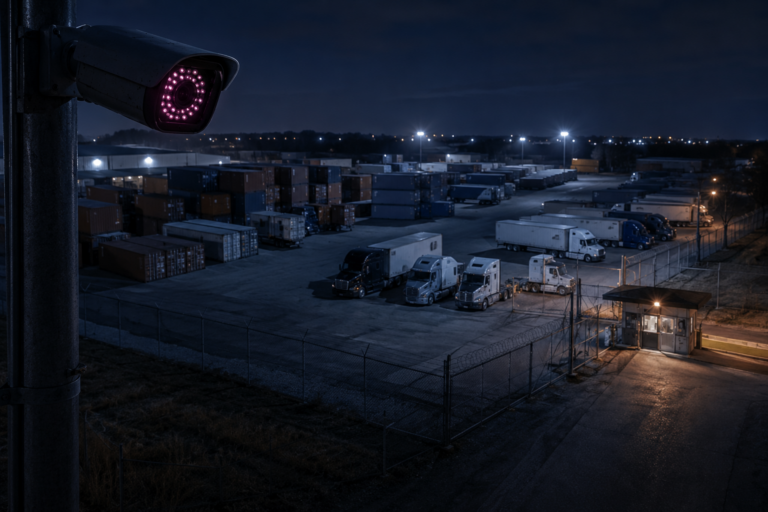
A vehicle lot security system designed for genuine coverage maps the entire property, identifies perimeter entry points and high risk interior zones, and positions cameras to eliminate gaps. Wide field and hemispheric lenses cover more ground per camera, which matters on a large lot where camera count has to be balanced against cost. Every corner of the lot is in view at the same time.
AI Detection, Not Just Recording
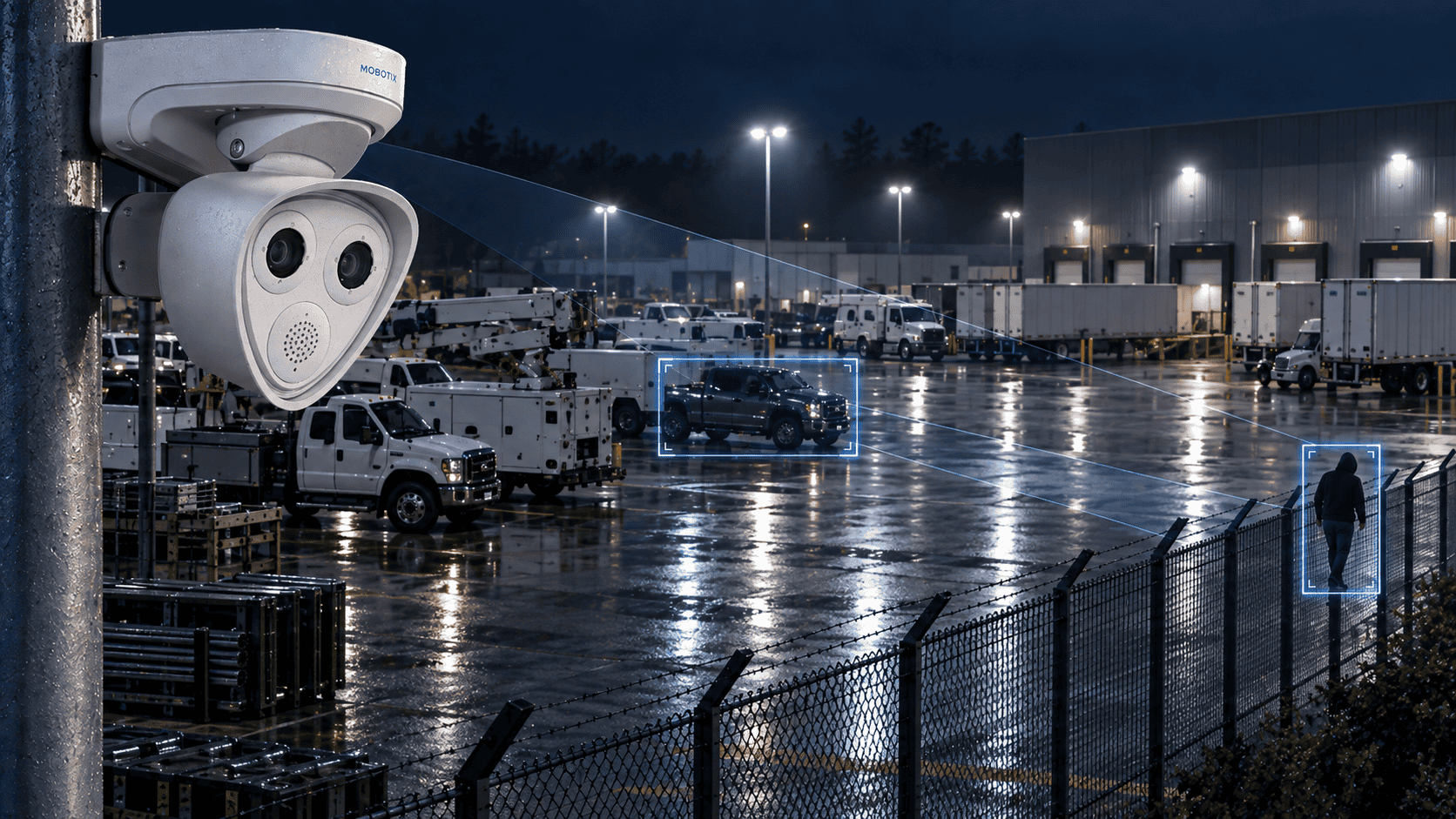
Cameras that record passively do not prevent anything. They document what happened after the fact. An AI analytics layer changes that by actively analyzing the feed and identifying the moment a person crosses a perimeter boundary, a vehicle enters a restricted zone, or activity begins that does not match expected patterns for that time of night. Detection happens in real time, not on playback.
The difference between recording crime and preventing it is the detection and response layer. We cover that distinction in detail in the difference between recording crime and preventing it.
Immediate Alerting and Response
Detection without a response path is still just documentation. When the system identifies an event, the alert needs to reach someone who can act on it while the event is still in progress. That typically means routing to a 24/7 monitoring station, to an on-call response team, or directly to local law enforcement with the relevant clip and location already attached.
For many vehicle lots, the response path involves a monitoring center that can issue an audio challenge directly through speakers on the property before dispatching. That combination of immediate detection, verbal warning, and dispatch notification resolves a significant percentage of intrusion attempts before physical contact is required.
The Coverage and Cost Comparison
A vehicle lot running one overnight guard pays $45,000 to $65,000 per year for coverage that has the structural gaps described above. A lot running two guards to try to address those gaps is paying $90,000 or more.
An AI monitoring system covering the same lot, with full perimeter camera coverage, AI analytics, and a professional monitoring plan, is typically a fraction of that annual cost, with better coverage as the outcome. The camera hardware pays back against one eliminated guard position in most cases in under twelve months. The ongoing monitoring cost is significantly lower than an ongoing guard contract.
You can see how we structure these projects on our security guard replacement services page, and we covered the operational side of this transition in how AI video monitoring is replacing overnight guards at vehicle lots.
What This Is Not
This is not an argument that every vehicle lot needs a sophisticated AI monitoring system regardless of size or risk level. A small private lot with a few company vehicles, good perimeter lighting, and a low history of incidents may be fine with a basic recording setup and good fencing. The case for active monitoring scales with the value of the assets, the size of the property, and the actual overnight risk profile.
But for dealerships, fleet yards, rental operations, auction lots, and any vehicle lot with significant asset value and overnight exposure, basic recording is not adequate coverage. It is documentation of losses you could have prevented.
Protect Your Business At All Times
Vehicle lots need 24/7 eyes, not necessarily 24/7 guards. The difference is the difference between active, simultaneous full-property monitoring and a single person walking a route. AI monitoring provides the coverage that vehicle lots actually need, at a cost that makes the economics straightforward. For operators still relying on overnight guards or passive cameras, the honest question is whether the current setup is actually watching the whole lot at the moments when it matters most.
If you want a realistic assessment of your lot’s overnight coverage, Vulcan will walk the property, map the gaps, and give you a straight picture of what the right setup looks like.
Frequently Asked Questions
Do vehicle lots really need active monitoring if they have a fence and cameras?
Fencing and passive cameras reduce opportunistic theft but do not address organized or persistent intrusion. Active monitoring, which detects events in real time and triggers a response while they are in progress, is what separates documentation from actual deterrence and prevention.
What is the biggest security risk for vehicle lots overnight?
Organized theft, catalytic converter theft, and vandalism are the most common overnight threats. All three benefit from the same condition: a predictable window when no one is actively watching the property. Closing that window with consistent detection and alerting is the most effective countermeasure.
How does an AI monitoring system handle false alarms at a vehicle lot?
AI analytics are configured to classify what is moving rather than triggering on any motion. This filters out wind, ambient movement, and lighting changes that cause constant false alerts with standard motion detection. The result is a system that alerts on people and vehicles in defined zones rather than generating constant background noise.
Is it safe to have no guard on site if AI monitoring is active?
For most vehicle lots, yes. The monitoring system handles detection and alerting, and a contracted response service or law enforcement handles physical presence when an alert is triggered. Removing the overnight guard position does not mean removing the response capability. It means separating detection from response, and using the right tool for each.
How long does it take to install an AI monitoring system at a vehicle lot?
Most installations are completed within a few days once the system design is finalized. The site assessment and proposal process, which is where coverage is mapped and camera placement is determined, typically takes place before any installation work begins. We cover what that process looks like on our scoping and installation page.