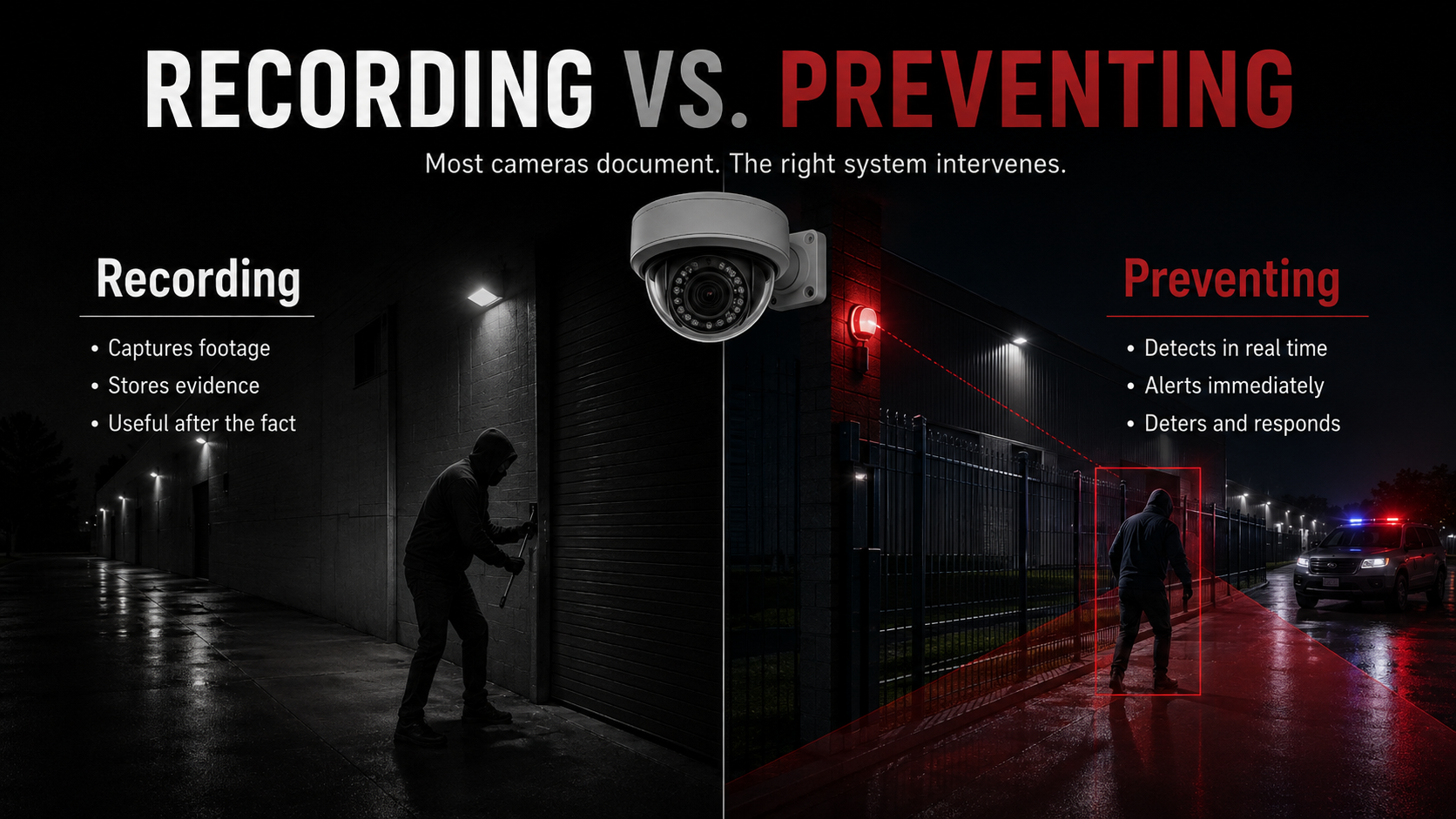
The Difference Between Recording Crime and Preventing It
Most business security cameras are evidence collection tools, not prevention tools. They record what happened, store it, and make it available after the fact. That is genuinely useful for investigations, insurance claims, and legal disputes. But it does nothing to stop the break in, the theft, or the fire while it is happening. Preventing crime requires a system that detects, responds, and deters in real time, which is a fundamentally different function from recording.
We install and support AI powered video security systems across Alabama, and the distinction between recording and prevention is the most important concept we talk about with new clients. This guide explains what separates a passive recording system from a proactive one, and why that difference matters more than camera count or resolution.
What a Recording System Actually Does
A standard security camera system, even a high quality one with good resolution and reliable storage, is fundamentally a documentation tool. It captures footage, saves it to a recorder or cloud storage, and makes that footage available when someone goes looking for it later.
The value of that documentation is real. Video surveillance reduces liability in insurance disputes, supports law enforcement investigations, and creates an evidentiary record that can matter significantly in legal or HR situations. None of that should be dismissed.
But consider what a recording system cannot do. It cannot alert anyone while a break in is in progress. It cannot tell the difference between a real threat and background movement without someone actively watching the feed. It does not deter an intruder who knows the cameras are there but also knows no one is monitoring them. A recording system documents the crime. It does not interrupt it.
What Prevention Actually Requires
Preventing a crime, or interrupting one in progress, requires three things that a passive recording system does not provide: real-time detection, real-time alerting, and a response capability that reaches the site before the event is over.
Real-Time Detection
A camera that records continuously does not detect anything. It captures everything equally, which in practice means it captures nothing specifically. Real-time detection requires the system to analyze the feed actively and identify events that meet defined criteria: a person crossing a perimeter line after hours, a vehicle entering a restricted zone, heat building in an electrical room, or someone loitering near a point of vulnerability.
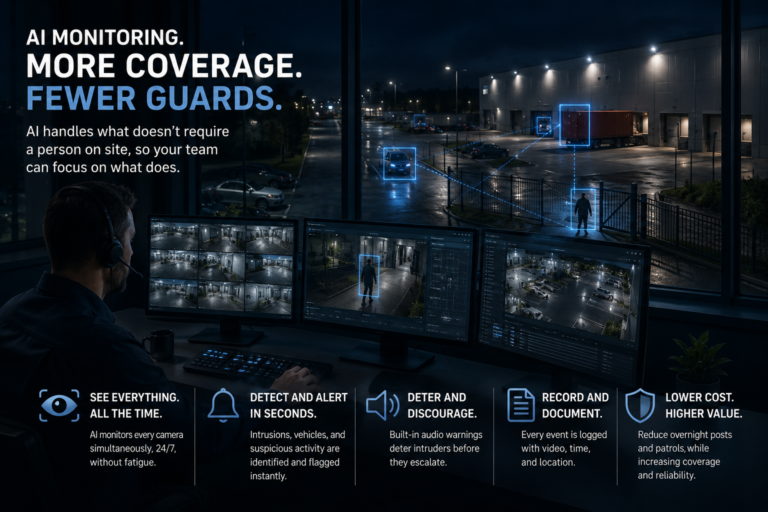
AI-powered analytics provide this layer. The system watches the feed continuously, applies rules built for the specific site, and identifies relevant events the moment they occur rather than waiting for a person to notice them on playback.
Real-Time Alerting
Detection without alerting is still just documentation. The event is identified, but no one acts on it until after the fact. A prevention-oriented system routes alerts immediately, through phone notifications, to a 24/7 monitoring station, or to on-site personnel, so a response can happen while the event is still developing.
The window between when a crime starts and when it is over is typically short. Vehicle theft, break ins, and vandalism events often conclude in under five minutes. If your alert system takes ten minutes to generate a response, you are still just collecting evidence, not preventing anything.
A Deterrence Layer
Prevention also operates before an event begins. Visible cameras paired with signage indicating active monitoring create deterrence that passive cameras alone do not. An intruder assessing a property will respond differently to obvious indicators of active monitoring than to cameras they know are simply recording. Audio deterrence systems, which can broadcast a real-time verbal warning when motion is detected in a restricted zone, add a layer that a standard recording setup cannot provide.
We cover how intrusion detection systems stop break ins before they happen in more detail, including the specific mechanics of how early detection changes the outcome.
The Gap Most Businesses Do Not Realize They Have
The uncomfortable truth is that most businesses with camera systems believe they have security when they actually have documentation. The system looks the same from the outside. Cameras are mounted, lights are blinking, and footage is being saved somewhere. The difference only becomes apparent when something happens and the camera footage shows exactly what occurred, but nothing stopped it.
This is a genuine gap. It does not mean the recording system has no value. It means the business made an investment in one category of protection while assuming they had something broader. Understanding the distinction is the first step to deciding whether the current setup is actually doing what the business needs it to do.
What a Prevention-Oriented System Looks Like
A security setup oriented around prevention combines several layers that work together rather than independently.
- AI video analytics that actively classify motion and identify events rather than just recording them.
- Defined alert rules tied to specific zones, times, and event types relevant to the property.
- A monitoring response that receives alerts in real time and can dispatch or contact on-site personnel while the event is in progress.
- Audio deterrence capability at high risk zones for sites where a real-time verbal response is appropriate.
- Camera placement designed for detection, not just documentation. Wide field views of choke points rather than narrow fixed cameras aimed at one area.
The combination shifts the system from a passive record to an active participant in site security. It does not eliminate the documentation value. It adds the prevention capability on top of it.
Which System Do You Actually Have?
A few questions help clarify where a current system sits on the recording-to-prevention spectrum.
- Does your system send alerts to anyone while an event is in progress, or only store footage for later review?
- Would anyone know within five minutes if an intruder entered your property after hours?
- Is your camera footage monitored in real time, or only reviewed after something is reported?
- Do your cameras cover entry and perimeter choke points, or are they aimed at interior spaces where a crime would already be underway by the time the frame captures it?
If the honest answers point toward documentation rather than prevention, that is a solvable problem. The hardware changes are often smaller than businesses expect, and the operational difference is significant.
Protect Your Business Now
Recording crime and preventing it are not the same thing, and most standard camera systems only do one of them. A prevention-oriented system requires real-time detection, immediate alerting, and a response capability that can reach the situation before it concludes. For businesses where security is more than a compliance checkbox, understanding that gap is worth the conversation.
If you want to know whether your current system is set up to prevent incidents or just document them, Vulcan can review your setup and give you a straight answer.
Frequently Asked Questions
Can a standard security camera system prevent crime?
A passive recording system provides some deterrence through visible presence, but it does not detect or respond to events in real time. Preventing crime requires active detection, immediate alerting, and a response capability that reaches the site before the event concludes.
What is the difference between AI video analytics and standard motion detection?
Standard motion detection triggers on any movement, including wind, lighting changes, and animals, generating constant false alerts that most systems end up ignoring. AI analytics classify what is moving and whether it meets defined criteria, producing alerts that are specific and actionable rather than constant background noise.
Does 24/7 monitoring make a camera system preventive?
Monitoring is the alerting and response layer that makes real-time prevention possible. Without it, even a camera with good AI analytics is still primarily a documentation tool because no one acts on what it detects until after the fact. Monitoring turns detection into response.
How quickly does a monitored system need to respond to actually prevent a crime?
Most break ins, vehicle thefts, and vandalism events conclude within two to five minutes. An effective response needs to reach the site, or at minimum trigger an on-site deterrent like an audio warning, within that window. A response that takes fifteen minutes is still evidence collection, not prevention.
Is a prevention-oriented system significantly more expensive than a recording system?
The hardware difference is often smaller than businesses expect. The primary additions are AI analytics capability and a monitoring service plan. For facilities where preventing even a single incident would justify the cost, the math usually works clearly in favor of the proactive setup.