How Many Security Guards Can AI Realistically Replace?
The number of security guards AI can realistically replace depends less on facility size and more on what those guards are actually doing. AI handles monitoring, detection, alerting, and documentation continuously and across an entire property at once. It does not handle physical intervention, emergency response, or situations that require a person on the ground. Understanding that distinction gives you a clear framework for estimating the real replacement number at your facility.
We install and support AI powered video security systems across Alabama, and guard replacement is one of the most common conversations we have with new clients. This guide breaks down what AI monitoring can and cannot do, how the math works by facility type, and what a realistic transition actually looks like.
What AI Can Do That a Guard Currently Does
Most security guard roles at commercial and industrial facilities break down into a set of repeatable functions. AI monitoring handles several of them more thoroughly than a single person can.
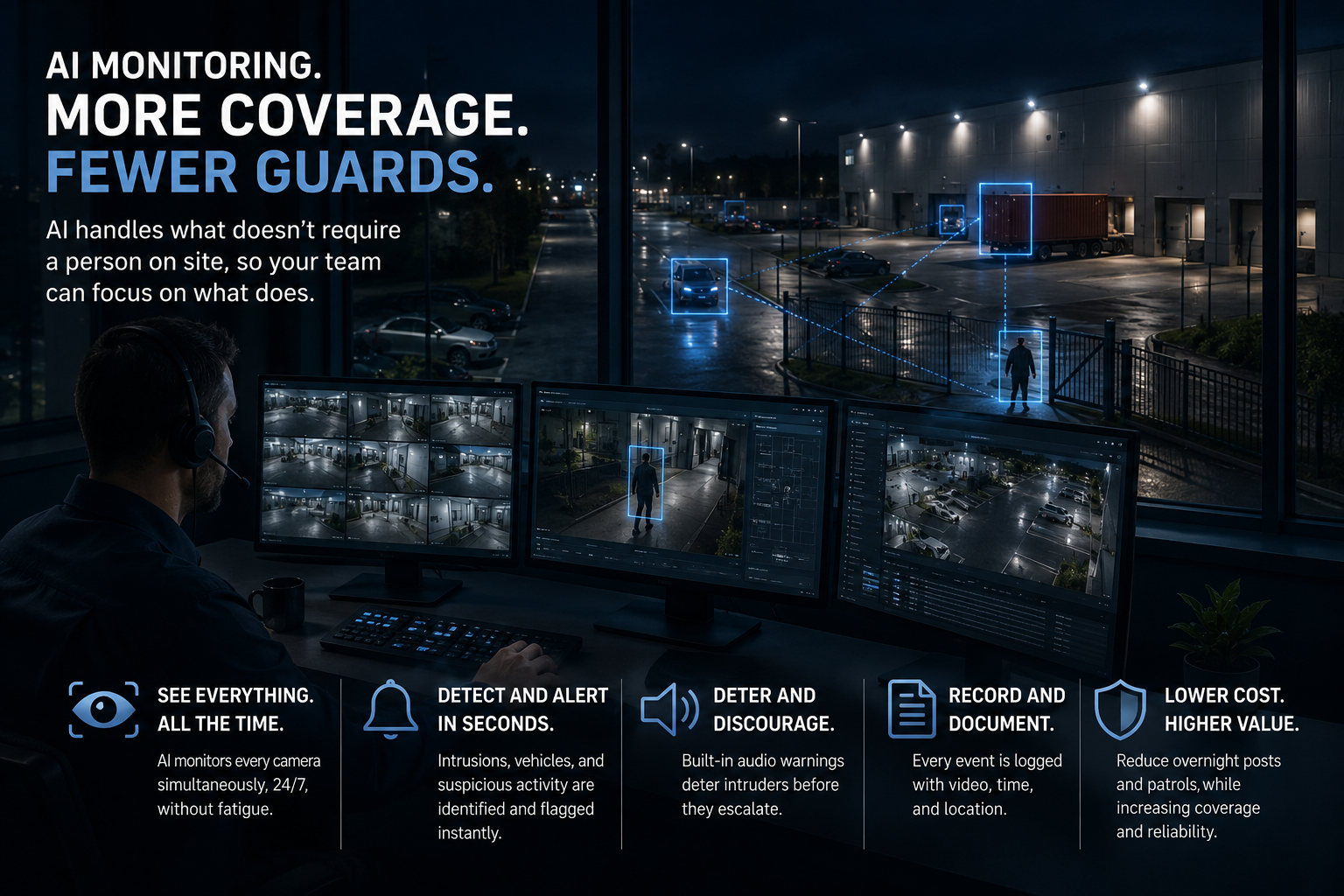
- Perimeter and property monitoring. A guard walking a patrol route sees one area at a time. An AI monitoring system watches every camera simultaneously, every moment of every shift, without fatigue or distraction. Coverage does not degrade at 3 a.m. the way human alertness does.
- Intrusion detection and alerting. AI identifies a person crossing a defined boundary or entering a restricted zone and generates an alert immediately. A guard on patrol might catch the same event ten to thirty minutes later, depending on route timing.
- Audio deterrence. Many AI monitoring setups include speaker systems that can issue a real-time verbal warning when an intruder is detected, often before any contact is required.
- Continuous documentation. AI systems log every event with timestamp, camera location, and clip. That documentation is immediate and complete, not dependent on what a guard noticed and wrote down at the end of a shift.
- After hours coverage at low activity times. The overnight window at most facilities has minimal legitimate activity. AI monitoring is well suited to this environment because the signal-to-noise ratio is high. Real events stand out clearly.
What AI Cannot Do
Being honest about the limits matters. A system that oversells AI replacement creates gaps that put real risk into the plan.
- Physical intervention. If an intruder does not respond to an audio warning, someone has to physically respond. AI monitoring triggers that response by alerting a guard, a monitoring center, or law enforcement. It does not replace the response itself.
- Visitor and access management requiring judgment. Deciding whether a contractor’s paperwork is in order, verifying employee identity, or handling a situation that requires reading the room is still a human function.
- First response to medical or safety emergencies. An AI system can detect an incident and trigger an alert. It cannot administer aid or manage a crowd while help arrives.
- Regulatory or insurance requirements for physical security personnel. Some facilities are required by contract or regulation to maintain a minimum staffed guard presence. AI monitoring supplements but does not satisfy those requirements on its own.
The Replacement Estimate by Facility Type
The realistic replacement ratio varies significantly depending on what guards are actually doing at a given facility. These are general ranges, not guarantees, and every site has specific variables that move the number.
High Replacement Potential
Facilities where guards spend most of their time doing passive monitoring and patrol with minimal human interaction are the strongest candidates. Overnight shifts at industrial sites, perimeter monitoring at vehicle lots, after hours coverage at warehouses and distribution centers. In these environments, AI monitoring can often handle the entire overnight monitoring function, allowing a facility to eliminate overnight guard shifts entirely or reduce to a single on-call response position rather than a staffed post.
Moderate Replacement Potential
Facilities with daytime hours, some public access, and mixed guard functions, like retail, commercial property, or facilities that receive regular deliveries and contractors, typically see a partial reduction rather than a full replacement. AI handles the monitoring and documentation layer while one guard handles access and exception response. The overall headcount goes down, but not to zero.
Lower Replacement Potential
Facilities with significant public presence, regulatory staffing requirements, or roles that require consistent human judgment and interaction, like hospitals, schools, or high traffic retail, still benefit from AI monitoring but are not candidates for significant guard reduction. The value there is in making the guards you have more effective, not in reducing how many you need.
The Cost Math
A fully loaded security guard position, including wages, benefits, workers compensation, overtime, turnover, and agency fees where applicable, typically runs $45,000 to $65,000 per year per position. A facility running three overnight guards, five nights a week, is spending well over $100,000 annually on overnight coverage alone.
An AI video monitoring system covering the same facility, including cameras, installation, and a 24/7 monitoring service plan, typically runs a fraction of that per year. The payback period on the system investment is often less than twelve months when replacing even one full time guard position. We break this out in more detail in video security ROI and whether cameras can replace a guard.
What a Hybrid Model Looks Like in Practice
Full replacement is not always the right answer, and we say that directly. The most common outcome for industrial and commercial facilities is a hybrid model: AI monitoring handles the detection and documentation layer around the clock, and one guard or an on-call response team handles physical response when the system triggers an alert. That model often lets a facility reduce from three or four overnight guards to one, or eliminate overnight staffing entirely while relying on contracted response.
We cover the broader comparison between AI surveillance and traditional guard setups in AI surveillance vs security guards: what is right for your business and in why Alabama businesses are rethinking security guards and adopting AI. You can also review our security guard replacement services page for how we approach these transitions specifically.
The Bottom Line
AI can realistically replace most of the monitoring and documentation functions that overnight and perimeter guards currently handle, at a fraction of the cost, and more consistently. What it cannot replace is physical presence and response. For most industrial and commercial facilities, that means the realistic answer is not zero guards but fewer guards, often significantly fewer, with AI handling the layer that does not require a person to be standing there.
If you want a specific estimate for your facility, Vulcan can walk the property, map the guard functions against what AI monitoring covers, and give you an honest number.
Frequently Asked Questions
Can AI video monitoring fully replace security guards?
For some functions at some facilities, yes. AI handles monitoring, detection, and alerting better than a single guard can. It cannot handle physical intervention, access management requiring human judgment, or regulatory staffing requirements. Most transitions result in fewer guards, not zero guards.
What types of facilities see the biggest guard reduction with AI?
Industrial sites, vehicle lots, warehouses, and distribution centers with overnight or after hours exposure tend to see the highest replacement ratios. These facilities have high monitoring demands, low human interaction requirements, and overnight windows where AI detection is most valuable.
How much does it cost to replace guards with AI monitoring?
An AI camera system with a monitoring plan typically costs significantly less per year than a single fully loaded guard position. The payback period on the hardware investment is often under twelve months when replacing even one overnight post.
Do I need to keep any guards if I install AI monitoring?
It depends on your facility, your risk profile, and whether you have contractual or regulatory requirements for staffed personnel. Many facilities move to an on-call response model rather than a staffed overnight post, which reduces cost while maintaining physical response capability.
Is AI monitoring reliable enough to trust without a guard on site?
When the system is properly designed and installed, yes, for the monitoring and alert function. AI monitoring does not fatigue, does not have blind spots created by patrol routes, and does not miss events during shift changes. The reliability question applies more to the response side than the detection side.