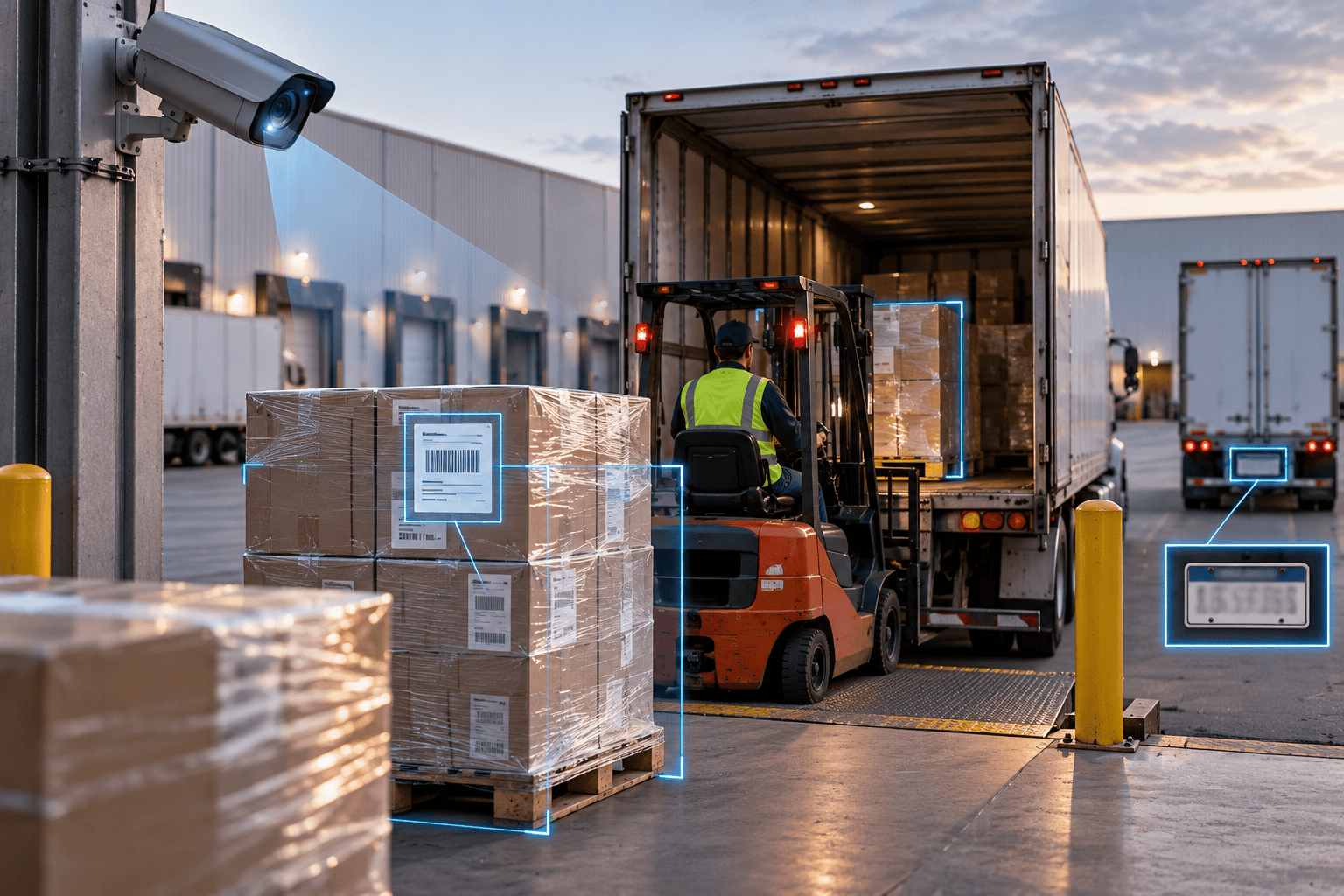
How AI Cameras Verify Shipments Before They Leave the Facility
AI cameras verify shipments before they leave the facility by reading what is on the dock and checking it against what should be there. Optical character recognition (OCR) reads labels, serial numbers, and truck plates. Object recognition confirms that expected items are present and flags what is missing. Every step is recorded with a timestamp, so if a customer disputes an order, you have video of exactly what was loaded, onto which truck, and when.
Vulcan Security Systems designs and installs AI-powered IP video systems for manufacturers, warehouses, and distribution centers across Alabama, and the loading dock is one of the places where those cameras earn their keep fastest. In this article, we cover the shipping errors AI cameras catch most often, how shipment verification works at the dock, how it fits alongside barcode scanning, and what to check before you add it.
Why Shipping Errors Cost More the Later You Catch Them
A shipping error caught on the dock costs a few minutes. The same error caught by the customer costs a return trip, a reshipment, a credit, and a little of their trust. If the order was bound for a production line, it may also cost them downtime on the line, and that is the kind of mistake a customer remembers at contract renewal.
Most outbound errors are simple: the wrong label, a missing carton, a pallet loaded onto the wrong truck. They happen most often at the end of a shift, during a rush, or when a dock is short on staff. Manual checks catch many of them, but a person verifying hundreds of cartons a day will eventually miss one. And without a record of what physically went onto the truck, a dispute comes down to your paperwork against the customer’s.
For Alabama manufacturers, the stakes keep growing. The state’s companies exported $23.7 billion in goods and services in 2025 to 190 countries, according to the Alabama Department of Commerce. When an order is crossing an ocean, there is no quick fix for a wrong pallet.
The Most Common Shipping Errors AI Cameras Can Catch
Verifying shipments with AI is not one feature. It is a set of specific checks, each built from capabilities we use today. These are the ones that prevent the most problems in practice.
A Wrong or Missing Label
OCR lets a camera read the text on a shipping label as the carton or pallet passes a fixed point. The system can confirm the label is present, readable, and matches the order it is supposed to belong to. A label that is missing, damaged, or printed for the wrong customer gets flagged before the freight is loaded.
We explain how this works in more detail in our post on how AI cameras use OCR to read text.
Missing Items or Incomplete Pallets
Object recognition can confirm that the items expected in a staging area are actually there before the truck is loaded. If a pallet that should be staged at a dock door is missing, or an item is left behind after loading, the system can alert the dock lead.
This works best when staging areas are clearly marked and items are consistent in size and shape. Mixed loose freight is harder to verify visually.
Serialized Parts Shipped Without a Record
For high value or regulated products, knowing exactly which serial numbers left the building matters. Cameras with OCR can read serial numbers and asset tags as items move toward the dock, creating a log of what shipped without a manual scan at every step.
This is especially useful for parts that later come back under warranty, where proving which unit shipped on which date settles the question quickly.
The Wrong Truck at the Wrong Door
OCR also reads truck and trailer plates at the gate or the dock door. Matching the plate to the scheduled carrier confirms the right freight is going onto the right truck, and it builds an arrival and departure log for every pickup.
For facilities with heavy truck traffic, that log also helps resolve detention and timing disputes with carriers.
Dock Activity Outside Scheduled Hours
Restricted zone detection can treat the dock as a controlled area after hours. If a person or vehicle enters it when no shipment is scheduled, the system alerts immediately, and our 24/7 monitoring team can respond with a voice-down warning or dispatch. Not every shipping loss is an error. Some of it walks out the door.
How AI Shipment Verification Works at the Dock
Good shipment verification depends far more on setup than on software. A typical deployment follows four steps:
- Map the outbound flow. Identify where freight is staged, where labels are applied, and which doors handle which carriers. Verification points go where every outbound item has to pass.
- Place cameras for reading, not just watching. OCR needs a steady angle, consistent lighting, and enough resolution to read text on a moving label. A camera positioned for general security coverage usually cannot do this well. Industrial IP video cameras placed specifically for each read point are what make it reliable.
- Connect to the reference data. OCR on its own only reads. Its value comes from comparing what it reads against your order list, carrier schedule, or authorized vehicle list.
- Set the alerts and the record. Decide who gets an alert for a mismatch and how fast. Every read and every alert is stored with a timestamped clip.
That timestamp matters more than most buyers expect. When a customer says an item never arrived, a clip showing it going onto their truck at a specific time usually ends the conversation. We cover why in why accurate timestamps matter in video security systems.
You do not need to cover every door at once. Many facilities start with the one or two doors that handle their highest value or most error-prone shipments, prove read accuracy there, and then expand. That keeps the first phase affordable and gives the dock team time to get used to the alerts.
Expect a short tuning period after installation. Read accuracy improves as camera angles, lighting, and rules are adjusted to how your dock actually runs.
AI Cameras vs. Barcode Scanning: When to Use Each
AI cameras do not replace your warehouse system or your scanners. They answer a different question.
- Barcode scanning is fast and precise, but it only proves an item was scanned. It does not prove the item went onto the right truck, or that nothing was skipped.
- AI cameras watch the physical flow. They catch the carton that was never scanned, the label that does not match, and the pallet left on the dock, and they keep video proof of all of it.
- Together, the scan confirms the system record and the camera confirms what physically happened. When the two disagree, you find out on the dock instead of from the customer.
If your dock runs well on scanning but you keep getting disputes you cannot prove either way, cameras are the missing piece. If you have no scanning at all, cameras can provide a strong first layer of verification on their own.
What to Check Before Adding AI Cameras to Your Dock
- Label quality: OCR is strongest on machine-printed, consistently placed labels. Handwritten labels are not reliable.
- Lighting at the dock: Glare from open doors and dark trailer interiors both hurt read accuracy. Plan lighting with the cameras.
- Speed of movement: Freight moving quickly on a forklift needs cameras with faster shutter speeds and frame rates.
- Integration: Decide early which data the cameras will check against and who owns that connection.
- Network security: Cameras tied to order data should sit on an isolated network. Our post on what makes a security camera system hard to hack covers how.
- Uptime: A verification camera that is offline verifies nothing. Proactive service maintenance catches outages before they leave a gap.
Catch Shipping Errors at the Dock, Not in a Customer Complaint
Every shipping error is cheapest at the moment before the truck pulls away. AI cameras make that moment count by reading labels, plates, and serial numbers, confirming expected items are present, and keeping a timestamped record of every load. Used alongside your scanners and warehouse system, shipment verification with AI cameras turns disputes you cannot prove into ones you can settle with a single clip.
If you want to see where AI cameras would fit on your dock, Vulcan will walk your outbound flow with you and show you exactly which checks are worth adding.
Frequently Asked Questions
Can AI cameras read shipping labels on moving pallets?
Yes, when the camera is positioned and configured for it. Read accuracy depends on label quality, lighting, angle, and how fast the freight is moving. A camera placed for general security coverage usually is not enough for reliable label reading.
Do AI cameras replace barcode scanners?
No. Scanners confirm the system record, while cameras confirm what physically happened on the dock. Most facilities get the best results using both.
Does shipment verification need to connect to our order system?
To flag mismatches automatically, yes. The camera reads the label or plate, and the value comes from comparing that read against what should be shipping. Without that connection, the cameras still create a searchable, timestamped record of every load.
How does video help with shipping disputes?
A timestamped clip shows what was loaded, onto which truck, and when. In most disputes over missing or wrong items, that record settles the question quickly.
Can the same cameras secure the dock after hours?
Yes. The cameras that verify shipments during the day can watch the dock as a restricted zone at night, alerting on any person or vehicle when no pickup is scheduled.