The Most Common Security Failures We See in Industrial Facilities (And How to Prevent Them)
Most industrial security failures are not dramatic breaches. They are quiet, avoidable gaps in placement, maintenance, and design that sit unnoticed until an incident forces someone to go looking for footage that turns out to be missing, unusable, or was never being captured in the first place. The same handful of failures show up across facility after facility, regardless of industry or size.
Vulcan Security Systems designs and installs industrial video security systems for manufacturing plants, warehouses, and distribution facilities, typically in the 50 to 100 camera range where these problems compound the fastest. In this article, we cover the most common failures we find during assessments and service calls, why they keep happening, and what actually prevents them.
Why Industrial Facilities Are Especially Vulnerable to These Failures
Industrial sites combine large outdoor perimeters, high value materials and equipment, and predictable shift schedules that leave the property empty and quiet for long stretches every day. That combination gives a security failure more room to hide than it would have on a smaller commercial property, and it gives anyone testing the property’s defenses more time to find the gap before anyone notices.
The Most Common Security Failures We See
Camera Placement That Misses the Moment That Matters
A camera mounted directly overhead at a dock door or entrance often records that someone entered without capturing enough detail to identify who it was. Wide, single cameras covering an entire yard sacrifice the resolution needed to make out a face or a plate at any real distance. Pan-tilt-zoom cameras, meanwhile, can only look in one direction at a time, which means they miss whatever happens elsewhere on the property while they are pointed somewhere else. Coverage that looks complete on paper often is not complete in practice.
Undetected Camera Downtime
A camera can fail quietly and stay offline for weeks or months if nothing is actively monitoring its status. We cover exactly what that costs in the real cost of security camera downtime. The most expensive failure is never the hardware itself. It is the incident that happens during a gap nobody knew existed.
No Nighttime Testing
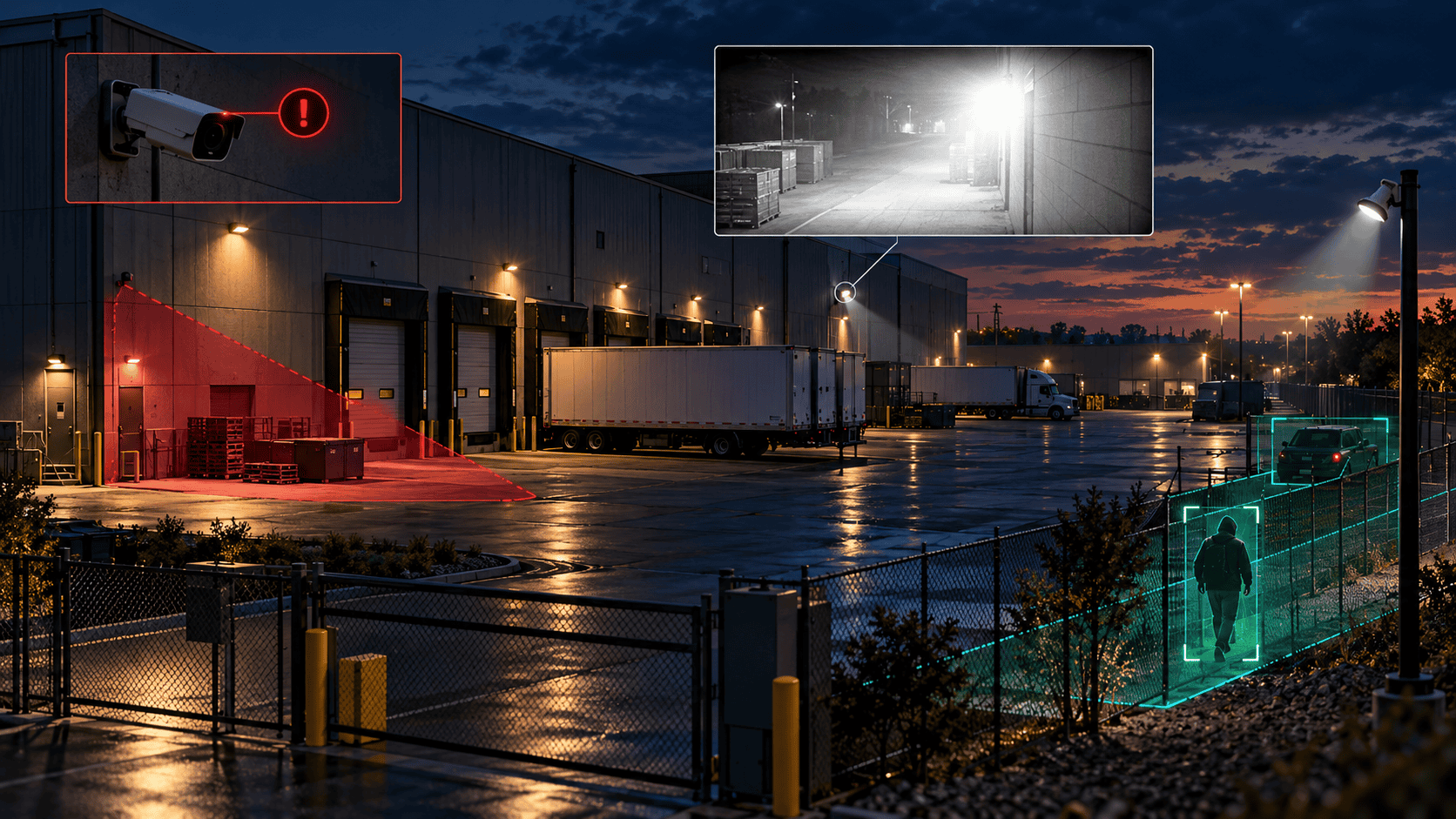
A camera that looks fine during a daytime walkthrough can fail completely after dark. Infrared light reflecting off a nearby wall, sign, or piece of equipment can wash out exactly the area a camera is supposed to protect, and most industrial incidents happen during off-hours, not during the shift when the site was last inspected. We break down the specific causes in why security cameras fail at night and how to fix it.
No Perimeter Intrusion Detection
Significant incidents rarely happen without warning. Perimeter testing, slow vehicle passes near access points, and individuals gathering near entrances are documented precursors to theft and break-ins, and we cover these patterns in more detail in Alabama crime trends industrial companies should know. Most facilities have no system in place to catch this activity because detecting it manually would require someone watching a live feed around the clock, which is not realistic at industrial scale.
Reactive Instead of Proactive Maintenance
More than 80 percent of video security issues trace back to network design, configuration, or connectivity problems, not the cameras themselves, a point we cover in why network design is the hidden foundation of video security systems. Obstructions creep into camera views, firmware falls out of date, and cabling degrades over time. Without a maintenance plan actively watching for this drift, a system that was fully functional at installation slowly becomes less reliable without anyone noticing until it matters.
How to Prevent These Failures
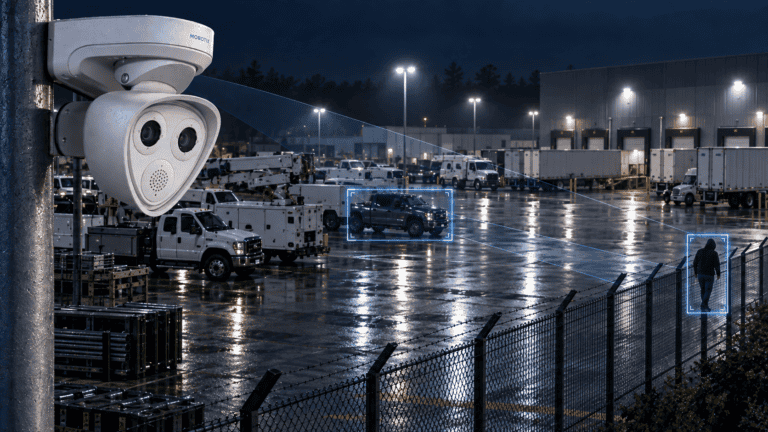
Prevention starts with an honest evaluation of what your current system can actually see, not what it was designed to see. A free on-site assessment that includes a nighttime walkthrough catches most of the failures above before they turn into an incident. From there, redundant coverage in loading docks and high value storage areas, thermal cameras for perimeter and fire risk detection, and AI-based perimeter and loitering detection close most of the remaining gaps.
Maintenance closes the loop. A proactive service maintenance plan monitors camera health and network status continuously, so a failure gets caught in minutes instead of months, and small issues get fixed before they compound into a full coverage gap.
Reactive vs. Proactive: Which Approach Actually Prevents Loss
Most industrial camera systems are built to record what happened, not to stop it from happening. That distinction matters more than most facilities realize, and we cover it directly in the difference between recording crime and preventing it. A camera that only documents an incident after the fact is doing half the job. AI-based detection, active monitoring, and a live audio response capability turn the same hardware into something that can interrupt an incident in progress, not just provide evidence once it is over.
Signs Your Facility Has One of These Failures
- No one at your facility can say with confidence when your cameras were last checked for uptime.
- Your exterior camera footage has not been reviewed after dark in the last year.
- Your perimeter has no automated alert for after-hours activity near fences or gates.
- Your system has grown over time through multiple vendors without an overall coverage plan.
- There is no maintenance contract actively monitoring camera and network health.
Most Industrial Security Failures Are Design Failures, Not Bad Luck
None of the failures covered here are unusual or rare. They are the predictable result of systems that were installed once and never re-evaluated against how the facility actually operates, how it looks at night, or how its network actually performs under real conditions. Facilities that avoid these failures are not lucky. They treat their security system the way they treat critical production equipment: something that gets inspected, tested, and maintained on a schedule, not something installed once and assumed to keep working forever.
If you want to know which of these failures might already exist at your facility, Vulcan will walk your site, test it day and night, and show you exactly what we find.
Frequently Asked Questions
What is the single most common security mistake at industrial facilities?
Undetected camera downtime is the most expensive and most common failure. A camera can fail quietly and stay offline for weeks or months without active monitoring, and the real cost shows up during the one incident that happened during that gap.
How often should an industrial facility test its camera system at night?
At minimum, once a year and after any significant change to the property, such as new equipment, lighting changes, or landscaping growth. Most industrial incidents happen during off-hours, so nighttime performance matters as much as daytime coverage.
Can AI detection actually stop a break-in before it happens?
AI detection cannot physically stop someone on its own, but it can flag perimeter testing, loitering, and unauthorized entry in real time and trigger a live audio response from a monitoring operator, which changes the outcome for many incidents that would otherwise go undetected until after the fact.
How much does proactive maintenance typically cost for an industrial system?
Vulcan’s proactive service maintenance is priced at 25 dollars per camera per month, covering uptime monitoring, outage alerts, and ongoing system health checks.
Do all industrial facilities need thermal cameras?
Not every facility needs them, but thermal cameras are especially valuable for large outdoor perimeters, fire and heat risk detection, and locations where standard lighting is insufficient for reliable nighttime coverage.